Mass law enforcement misconduct news, Mar. 9-15 (and Sunshine Week!)
The latest media reports of alleged law enforcement misconduct in Massachusetts—and bonus Sunshine Week commentary

It’s Sunshine Week! This annual event celebrates freedom-of-information laws and the public’s right to know. It’s coordinated by the Joseph L. Brechner Freedom of Information Project at the University of Florida’s College of Journalism and Communications.
For previous Sunshine Weeks, I’ve shared my advice about making public records requests in Massachusetts. You can read it here:
 Andrew Quemere
Also check out this podcast to hear my advice about filing an administrative appeal when a government body ignores your request, denies it, inappropriately redacts information, or tries to charge an excessive fee:
And check out my recent commentary about how to fix one of the Public Records Law’s biggest flaws:
 Andrew Quemere
While there’s probably no such thing as a perfect Public Records Law, one obvious fix would be to give the supervisor of public records the right to take agencies to court when they violate her orders. The attorney general should not serve as a gatekeeper who prevents these cases from going to court. If the commonwealth is going to have a transparency watchdog, she should actually have the ability to carry out her mandate.
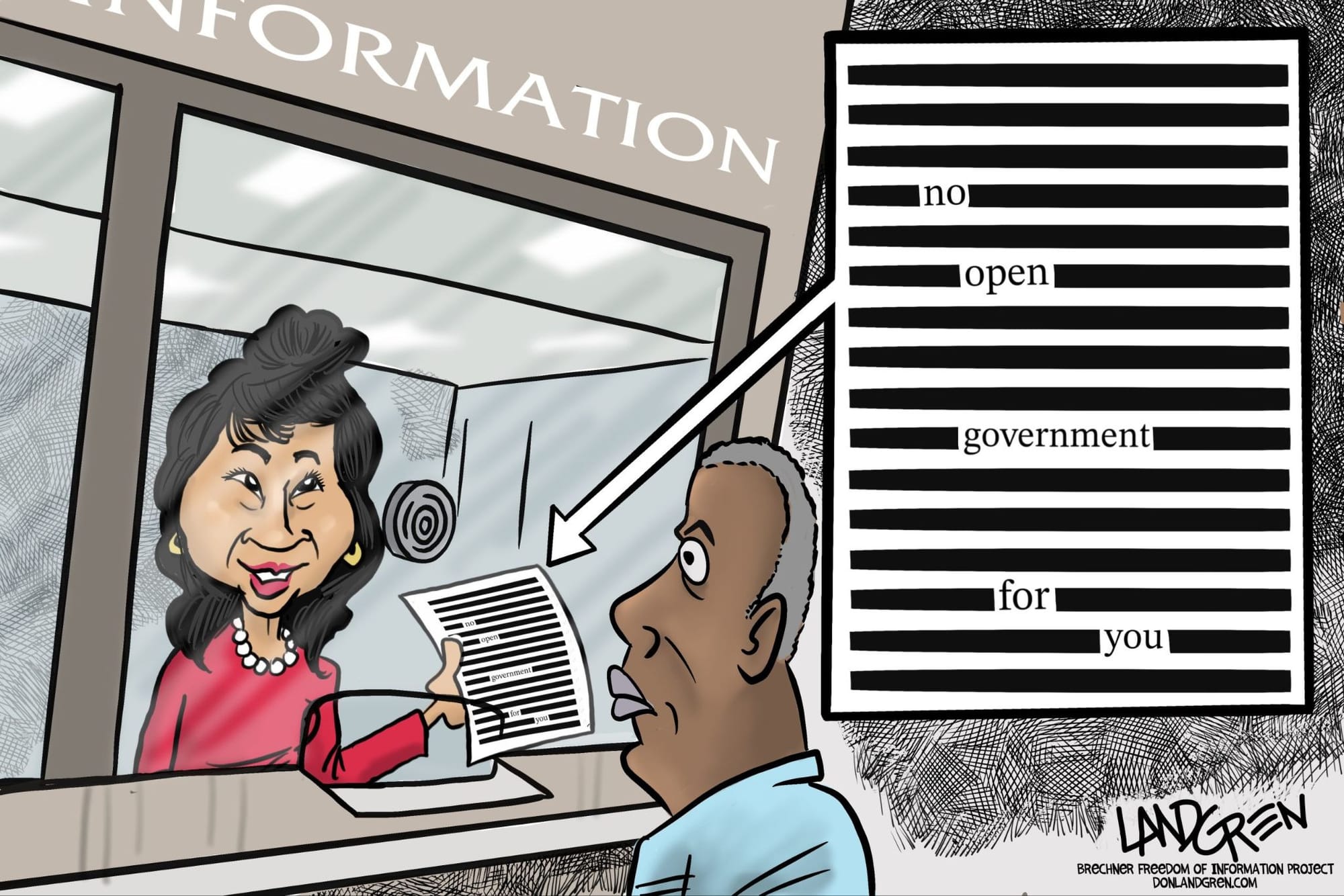
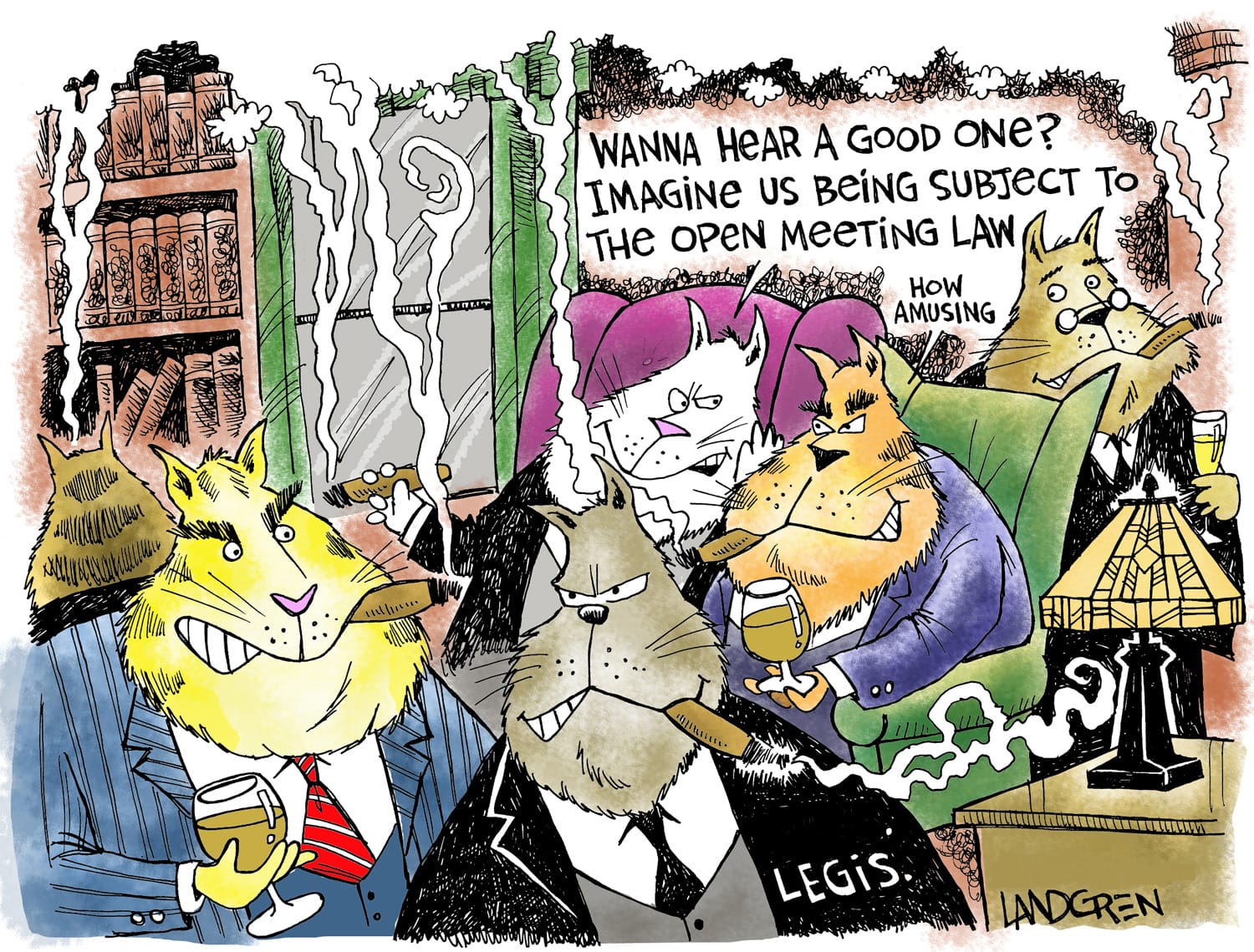
Massachusetts-based cartoonist Don Landgren shared these political cartoons for Sunshine Week:
“They don’t see themselves as accountable to the public or the law even”
The Springfield Republican’s Greta Jochem on Sunday published this detailed story about the Massachusetts State Police’s systemic—and, in my opinion, deliberate—failure to comply with the Public Records Law.
According to Jochem’s reporting:
Data the State Police must report to the state shows the agency responded to about 25% requests last year in the same quarter that they were submitted. That rate was similar to the previous few years’ figures.
In less than 1% of cases last year, a requester received records from the State Police within the quarter they asked for them. The agency opted to upload the data in quarterly batches and so the numbers do not reflect what happened, if anything, to the request after that quarter. Additional data the State Police provided The Republican did not provide more information on the response rate or how often someone received requested records. …
The agency faces ongoing lawsuits about records access, including from the Committee for Public Counsel Services, the state’s public defender service, which alleges the State Police have a “regular practice of flouting the Public Records Law.” The Boston Globe is also suing and alleges the State Police have a “serial pattern and practice of violating the Public Records Law.”
Jochem also quoted me in the story:
Andrew Quemere is a Massachusetts freelance journalist who writes “The Mass Dump,” a newsletter focused on law enforcement and public records. Over the last decade he’s filed nearly 50 appeals over requests he made to the State Police.
In the past, he has struggled to get responses to his requests unless he followed up. “That is in general my experience – you don’t get a response unless you work for it, which is not how the public records law is supposed to work,” he said.
In May 2024, he requested employment and internal affairs records for one officer. He got a response in October informing him the department was researching the request, but because it had been more than 90 days since he submitted the request, they wanted to know if he was still interested. If he didn’t reply in 10 days, the agency would close his request. The law says the agency should itself have replied in 10 business days.
When asked how often requests are closed for that reason, a state police spokesperson said they don’t track why requests are closed.
“It’s not a big ask for such a well-funded agency to simply follow the law,” Quemere said, pointing to the State Police’s half a billion dollar budget. “Especially when they claim their role is law enforcement, at the minimum we should expect law enforcement to follow the law.” …
As a journalist, police records access is an issue in his work, but he thinks the alarm should go beyond the media industry. “I think the wider public needs to be concerned about it,” he said. To him, the State Police’s lack of compliance “speaks to the ideology and culture of police in this country – that they don’t see themselves as accountable to the public or the law even.”
Read the rest of this story here.
Law-enforcement misconduct news
Here are the media reports of alleged law enforcement misconduct in Massachusetts that I’ve tracked during the last week.
Stories involving federal law enforcement
- “A 14-year-old high school freshman detained by federal immigration agents in a parking lot in Marlborough has been returned to her family after spending a day at a juvenile facility in New York. However, the government has begun deportation proceedings against the Brighton High School student, identified as B.E.S. in federal court records. That’s despite a federal lawyer’s statement [on March 11] that the government was not seeking to deport her.” (GBH)
- “A federal judge [last] week ordered the immediate release of a man who came [to the United States] as a a Cambodian refugee in 1983, but who has been locked up in an ICE cell for most of the last two months with ICE refusing to tell him what the ‘changed circumstances’ are that require him to be shoved out of the country after decades here - and without any proof Cambodia will actually take him back.” (Universal Hub)
- “Gov. Maura Healey and Attorney General Andrea Campbell announced [March 13] that the state is launching a new online portal for residents to report incidents of alleged misconduct by ICE officers operating in Massachusetts. … The portal is explicitly for reporting potentially unlawful activity and misconduct by federal agents enforcing immigration law.” (Boston.com)
And yet, as I recently reported, Maura Healey refuses to end the Massachusetts Department of Correction’s agreement to collaborate with ICE on deportations or support legislation that would stop county sheriffs from jailing people for ICE.
 Andrew Quemere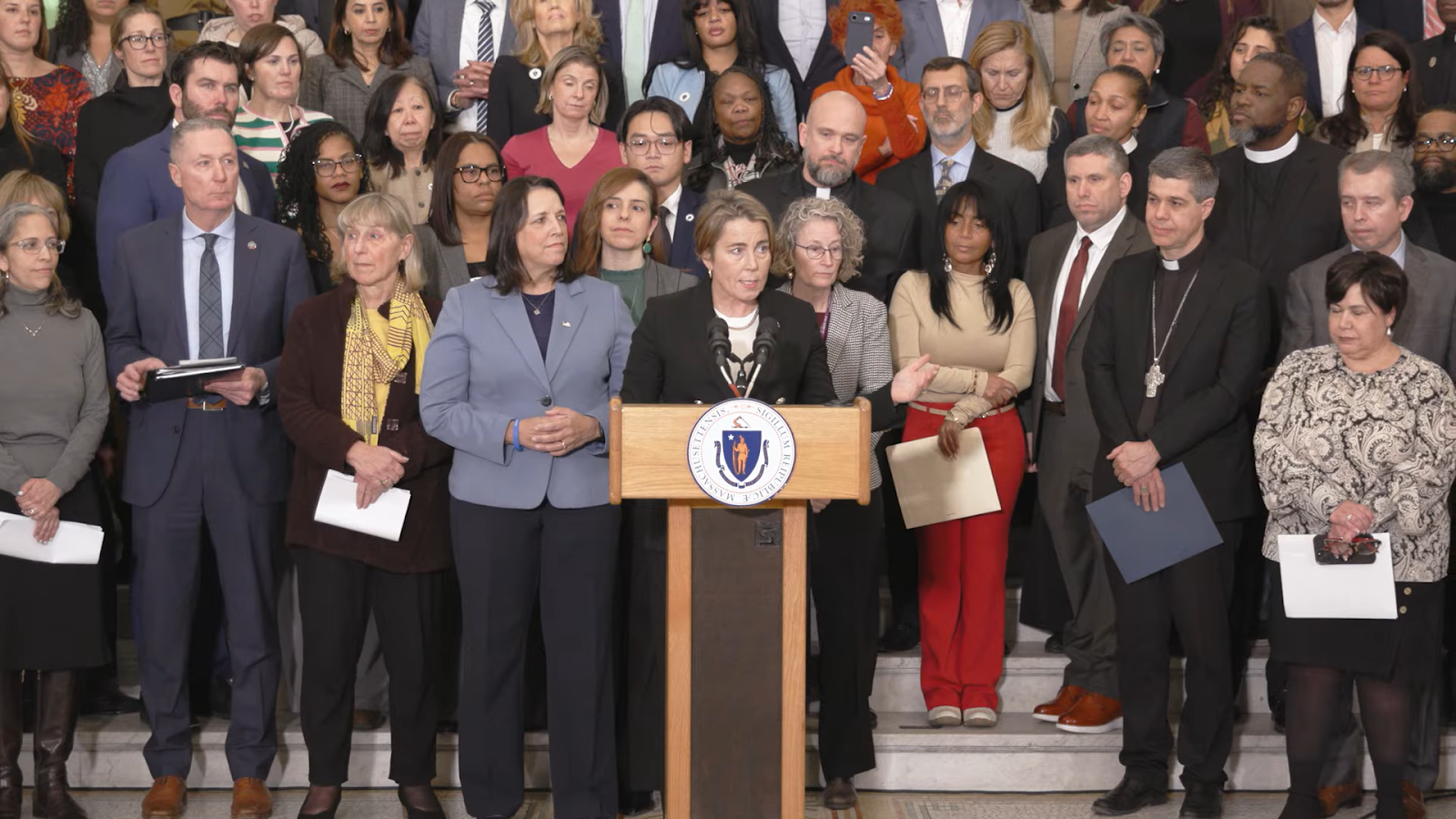
Stories involving state and local law enforcement
The latest on the State Police cover-up
- “A judge has delayed a murder trial in Lowell for the second time over concerns with a statie who investigated the case and has been accused of driving drunk during a fatal cruiser crash. The first-degree murder trial of brother Billoeum, Billy, and Channa Phan will continue to a status conference in June while their defense lawyers and prosecutors sort out any potential prosecutorial issues caused by Sgt. Scott Quigley’s involvement in the case.” (Boston Herald)
- “Before State Police Sgt. Scott Quigley crashed head-on into a wheelchair van in 2023 — while on duty and allegedly intoxicated — he’d been involved in seven other cruiser crashes. According to a Mass State Police cruiser crash driver history obtained by the Herald, he was only ‘at fault’ for one of the crashes, but the agency has denied a public records request asking for reports that detail each incident.” (Boston Herald)
- “Defense attorneys for the Phan brothers, who are charged with the 2020 shooting murder of 22-year-old Tyrone Phet, argued [on March 13] that revelations involving case investigator Sgt. Scott Quigley’s alleged misconduct presents a ‘sea change’ in the case that should release the brothers from jail under personal recognizance. … Judge Christopher K. Barry-Smith took bail arguments under advisement but did not rule on bail by the end of the court day.” (Boston Herald)
More misconduct allegations
- “A judge [on March 9] has denied a motion filed by attorneys for former Stoughton Police Officer Matthew Farwell seeking to have the charges against their client in connection with the Sandra Birchmore case thrown out.” (NBC10 Boston)
- “The Committee for Public Counsel Services, the state’s public defender’s office, has filed several lawsuits over records requests to the State Police. In one open suit initiated in 2023, the agency says that none of the 14 records requests it made to the State Police over two years were responded to within the required period. About half are still not resolved. … The Boston Globe filed a lawsuit in September accusing the State Police of a ‘serial pattern and practice of violating the Public Records Law,’ after it says the agency failed to properly respond to 12 public records requests [in 2025].” (Republican)
- “The Framingham Police Department says it determined that two police officers violated a policy against ‘criminal conduct’—but the department has provided few details about the allegations and has demanded $525 for the officers’ internal affairs records. Former Framingham police officer Reece Black and former Detective Kyle Pursell were both found to have violated policies related to criminal conduct, controlled substances, association with known criminals, and conduct unbecoming an officer/employee, Lieutenant Rachel Mickens revealed.” (Mass Dump)
 Andrew Quemere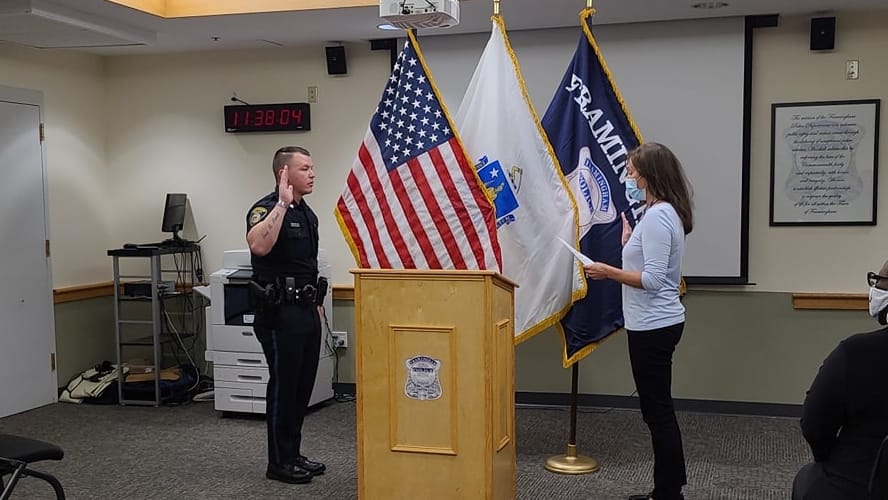
Other News
SJC rules charter schools are subject to Public Records Law (CommonWealth Beacon)
The Supreme Judicial Court ruled that charter schools must comply with the state’s public records law, settling an argument at the heart of Mystic Valley Regional Charter School’s years-long refusal to respond to records requests.
The Malden school, breaking from the position of most charter schools in the state, argued this type of school is only quasi-public, with certain characteristics that make it different enough from other public schools that it could refuse to comply with the general public records law.
Excluding charter schools would frustrate the “core transparency mandate” of the law, wrote Justice Serge Georges, Jr. for a unanimous court on [March 10], given that they are “public schools funded with public money and charged with performing a quintessential public function.”
Mass. Senate asks SJC for advisory opinion about constitutionality of law that would apply Public Records Law to lawmakers (CommonWealth Beacon)
Lawmakers have spent months whispering concerns that ballot questions to subject them to the public records law and to reform the system of legislative stipends are unconstitutional, and now senators want the state’s highest court to provide some important feedback.
The Senate voted [on March 12] to ask the Supreme Judicial Court for opinions on whether the pair of reform-the-Legislature ballot questions run afoul of the constitutional separation of powers, a rare move that could reshape debate heating into the thicket of election season.
It’s a different legal technique than a lawsuit challenging either measure’s eligibility to go before voters, and, unlike a decision in such a case, the answers that justices hand down would not be legally binding.
Thanks for reading! If you’d like to keep The Mass Dump running, please consider offering your financial support, either by signing up for a paid subscription to this newsletter below, becoming a Patreon supporter, or sending a tip via PayPal or Venmo. Your support pays for this aggregation project and original investigative reporting. A monthly subscription is just $5. It would be a lovely way to celebrate Sunshine Week.
Even if you can’t afford a paid sub, please sign up for a free one to get news about wrongful convictions, police misconduct, public records, and stuff like that—and please share this article on social media.
You can follow me on Bluesky and Mastodon. You can email me at aquemere0@gmail.com.
This is how #Massachusetts Governor Maura Healey is talking about Trump's brutal, unprovoked attack on Iran that has killed countless civilians, including schoolgirls—by lumping it together with tariffs as an affordability issue instead of in moral terms. #mapoli www.nbcboston.com/news/local/h...
— Andrew Quemere (@andrewqmr.bsky.social) 2026-03-11T20:55:39.285Z
Removal of federal data affects us in our hometowns
By Miranda S. Spivack
Feb. 23, 2026
The following commentary was made available by the Sunshine Week website.
Federal data on rising hunger, on long term trends in maternal and infant mortality, information about preparing for disasters - gone.
Freedom of Information Act offices eviscerated across the federal government.
The Department of Government Efficiency led by Elon Musk insisted it was not required to open up its records to the public, even when courts found otherwise.
Getting information of many types from the federal government – which has never been easy – is now a nearly impossible task.
And even if the government does answer a request for its public records, how reliable will the information be? The disappearance from government websites of decades of data on health, diseases, education, criminal justice, civil rights are among the many datasets that the Trump administration has dumped. The experiences of two key government agencies are emblematic of this information chasm. Experts who track certain data found that more than 3,000 pages of information were removed from the Census Bureau website, and similar losses occurred at the Centers for Disease Control.
Since taking office in January 2025, President Trump has taken several steps – via executive order, and by making public statements - to demand that federal agencies ditch their data. So even if FOIA offices were somehow miraculously reinvigorated, they will have less and less information to give out. And that is information that your tax dollars already paid for, and by all rights, belongs to you.
The bottom line is that public is being kept in the dark and decision making is hobbled. Yet the outcry over disappearing data has been limited mostly to academics, scientists, finance people and others who regularly mine government data and documents to inform their work.
One of the biggest challenges that open government advocates perpetually face is how to build support for the idea that open government is government for all - not just for the experts or the academicians.
But there are many ways to enlist broad support for open and accurate information from the government. For starters, show how government secrecy and disappearing data have a direct effect on your neighbors and their communities.
Take for instance the move in April 2025 by the CDC to stop collecting long term data on maternal and infant mortality. Might this not be information that people beyond the medical profession, those making decisions in state and local government about how to allocate public health dollars, and pregnant women and their partners might want to know?
Or what about a decision to end a Justice Department database that tracks law enforcement misconduct? Wouldn’t it be helpful for residents of communities to have this information, along with state and local governments and federal agencies who might be hiring and need to know the backgrounds of applicants?
Data collection on food insecurity - that is to say hunger – has also been limited by the federal Department of Agriculture. The agency said in announcing the end of the program that it had other sources for the information. Groups that track the data say the USDA’s move has made it difficult to understand the breadth of hunger in the United States and push for policies to end it.
Data about the state of public schools in the United States is also among the missing.
Federal infrastructure data is disappearing. That sounds wonky, but here’s why it matters: “It’s made it harder to track conditions at prisons, decide how to increase security in cities during large events and plan natural disaster responses, according to researchers, and state and local government employees…” said a report from NOTUS.
The American Statistical Association predicted extensive damage to democracy due to disappearing data in a report issued in December. “Federal statistics are a core democratic institution, supporting free and fair elections, fair and impartial courts, informed civil discourse, and other vital functions that are not easily replicated by the private sector.”
The disappearance of government information can also put more power in the hands of private entities and businesses, themselves often exempt from public records laws.
“Removing government databases can also transfer power from public to private entities, strengthen monopolies, hobble innovation, and promote autocracy,” according to a recent New England Journal of Medicine article.
As Sunshine Week – an annual celebration of government transparency - arrives in mid-March, open government advocates must do more to explain the importance of the nation’s information infrastructure. Anyone interested in preserving First Amendment rights to assemble, petition the government, speak freely, practice religion, and protect a free press needs to explain to their neighbors why they should care about disappearing data. Start at the local level, where your community’s health department is being affected as are your public schools – and keep pushing at the state capital and in Washington, D.C. For what you do close to home can ripple across the country, and make a big difference in what kind of nation we will become – and whether information from governments, including state and local governments that rely on federal information, can be trusted to be truthful.
Miranda S. Spivack is the author of Backroom Deals in Our Backyards: How Government Secrecy Harms Our Communities and the Local Heroes Fighting Back (The New Press 2025). She is vice president of the D.C Open Government Coalition. You can reach her at mirandaspivack@yahoo.com and at https://www.mirandaspivack.com.