Judge hears arguments about whether Northwestern DA must release names of cops charged with crimes
For years, DA David Sullivan has spent taxpayer money on fight against police transparency

A lawyer for The Mass Dump told a judge on December 3 that Northwestern District Attorney David Sullivan’s office is legally required to disclose the names and case numbers of police officers who have been charged with crimes like possession of child pornography, assault and battery, and driving under the influence.
After the Dump requested the information under the Massachusetts Public Records Law in January 2022, prosecutors insisted that they must withhold the names of the accused officers and the case numbers under a state law intended to protect people’s criminal records. That refusal led the Dump to file a June 2023 lawsuit alleging that Sullivan’s office was misapplying the law and acting in bad faith. In response, Sullivan hired a private law firm at taxpayer expense to resist releasing the information.
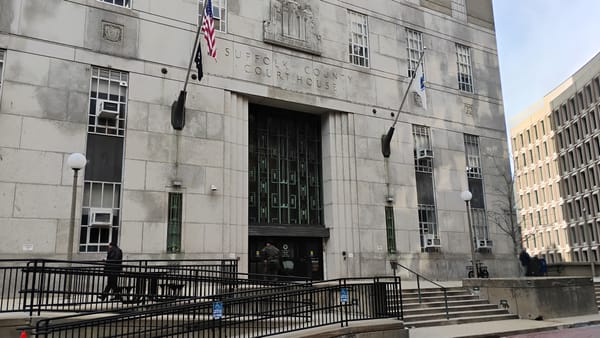
At a hearing on December 3, nearly four years after the Dump first requested the information, Suffolk County Superior Court Justice Julie Green heard oral arguments in the lawsuit. Green did not say when she will issue her written ruling.
The Dump’s public records request sought the district attorney’s Brady disclosures about police officers. These documents—which are named after a 1963 US Supreme Court decision—are used by prosecutors to inform defendants in criminal cases about alleged misconduct by officers testifying against them. Prosecutors are required to make these disclosures so that defendants can challenge the officers’ credibility in court.
Sullivan’s office provided copies of the Brady disclosures but blacked out the names of officers who had been charged with crimes, citing the state’s Criminal Offender Record Information (CORI) law. His office also removed docket numbers that were associated with the officers’ criminal cases and with the cases in which the officers were potential witnesses. Docket numbers are identification numbers that courts assign to cases; the public can use them to look up and obtain court records related to those cases.
At the hearing, the Dump’s attorney, Mason Kortz, said the Massachusetts Supreme Judicial Court has established precedent that defendants’ names and docket numbers are generally not protected by the CORI statute.
“Learning about a criminal investigation, arrest, prosecution, conviction, or sentence from a public record, it does not violate the CORI law,” Kortz told the judge.
Kortz, a clinical instructor at Harvard Law School’s Cyberlaw Clinic, is representing the Dump pro bono. Students from the law clinic helped him prepare the case.
Patrick Hanley, an attorney for Sullivan’s office, said prosecutors are “not willy-nilly saying we want to protect police officers.”
“What they’re doing is only protecting what constitutes CORI,” he continued. “And the reason that the CORI law exists is to protect … the privacy of people’s criminal records.”
Sullivan’s office is represented by Hanley and Elizabeth Keeley of the Boston-based private law firm Butters Brazilian. The district attorney’s office agreed to pay $350 an hour for each of the two attorneys and $75 an hour for the work of clerks and paralegals, according to a July 2023 agreement obtained by making a public records request.
Butters Brazilian had billed taxpayers $13,454.17 for work related to the case as of July 31, according to invoices released by Sullivan’s office. Those records do not reflect charges for the final draft of the district attorney’s most recent motion or the oral arguments on December 3. The Dump requested updated billing records after the hearing, but Sullivan’s office has not yet responded.

If Sullivan’s office loses the lawsuit, the court could order it to pay the Dump’s legal fees. Sullivan also implied in a 2023 radio interview that his office will appeal if the court sides against it, which would add to the burden on taxpayers.
“If it’s got to go up to the Supreme Court for them to make that decision whether the Public Records Law overrides the CORI law, then we’ll let the Supreme Court decide,” he said at the time.
You can listen to the hearing here:
“Not a Prohibition on Disclosing Public Records”
At the hearing, Kortz said that the CORI statute prohibits government agencies from releasing a person’s complete criminal record, not information about individual cases.
“You can get arrest logs,” he said. “You can get the daily police blotter. You can go down to the courthouse and pull files from any unsealed case. And that doesn’t violate CORI.”
In a 2003 decision, he said, the Supreme Judicial Court ruled that district attorneys were required to release names and docket numbers after The Boston Globe requested information about cases of alleged corruption by local officials over a five-year period.
In a 2020 opinion, the SJC ruled that prosecutors could redact names and docket numbers in response to a Globe request for the data from their internal case-management systems. But in that case, Kortz said, the justices determined that the amount of information the Globe sought was so vast it would have allowed the newspaper to create a “shadow CORI database.”
Kortz said that the data in the 2020 case included ID numbers for each defendant, which would have allowed a person to compile people’s complete criminal records and undermined the purpose of the CORI statute.
Kortz said that the Dump’s request was limited to a specific set of defendants and a specific set of circumstances, “which is that the DA has determined the offense is the type that requires mandatory constitutional disclosure under Brady.”
“And most importantly, there is no way based on these records to know if any given offense that shows up is an officer’s entire criminal history,” Kortz said. “We wouldn’t be able to confirm that without going down to the courthouse, going to every courthouse, really, and looking for [the officer’s] records. And that’s exactly what … the SJC said is not prohibited by CORI.”
Hanley said that this case was different from the 2003 case cited by Kortz. Hanley said that the Globe had only requested information about cases involving corruption, which would not “elicit [a person’s] full criminal record.” In contrast, he said, the Dump’s request wasn’t limited to specific charges.
“I haven’t seen any of these officers’ criminal records,” he said. “But the way the [Brady] letters are written, it leaves the impression that they are the full and complete record of this person. That’s the point of the disclosure.”
Hanley began his argument by saying that some of the Brady letters reference pending criminal cases, not convictions.
“I’m just not following your point. Why does it make a difference … whether a case is pending or complete?” Justice Green asked.
“It doesn’t,” Hanley said. “Criminal records … contain lots of information. Often they contain information that includes cases that don’t result in a conviction. I suggest that that’s one of the reasons that there is an exemption to the public record statute for CORI information.”
Hanley said that the district attorney’s office created the Brady letters to satisfy its obligation to provide criminal defendants with exculpatory evidence. He said prosecutors send the letters to defense counsel but do not file them with courts.
“This isn’t information that anybody would get from the court,” he said.
Green said she thought the case wasn’t about whether the documents themselves were CORI, but whether the information the district attorney’s office redacted was CORI.
“I would suggest that the combination of name and docket number is CORI information, and so that’s why those redactions are reasonable,” Hanley said. “Those pieces of information are what would lead anybody to be able to create a shadow criminal record of this officer.”
Hanley said the redactions made by the district attorney’s office were “the bare minimum redactions.”
Kortz countered by telling the judge that the district attorney’s brief contained a definition of CORI that omitted language explaining that it does not apply to “chronologically maintained court records of public judicial proceedings.” The SJC has ruled that docket numbers fall under this exception to CORI, he said.
Kortz also cited another 2020 decision in which the SJC ruled that police departments were required to disclose arrest reports and booking photos related to drunk-driving cases against police officers.
“The CORI statute is not a prohibition on disclosing public records … that talk about arrest, that talk about charges, that talk about convictions,” Kortz said. “It’s a prohibition on disclosing someone’s state-compiled CORI report.”
“So the distinction you’re drawing,” Green responded, “is between an individual case, which is revealed by these documents, and a complete compilation by the state, which, it seems to me, these documents would not reveal.”
“Yes, exactly,” Kortz said.
“It Seems Like They’re Not Taking It That Seriously”
During his argument, Hanley told the judge that Sullivan’s office was acting in good faith when it withheld the names and docket numbers. Under the Public Records Law, the judge can fine the district attorney’s office up to $5,000 in punitive damages if she determines it acted in bad faith.
Hanley said that Sullivan’s office provided the names of officers who were accused of misconduct in internal investigations because that information is not CORI.
He pointed to one Brady disclosure that prosecutors disclosed without redactions, noting that the information was “pretty damaging to [the] police officer.” According to the disclosure, Amherst police officer John Chudzik was found in 1999 to have testified untruthfully in a drunk-driving case.
“The officer is identified by name,” Hanley said. “And I suggest that this shows the good faith … that the Norfolk [sic] DA’s office was acting with when it is trying to thread this needle. [It’s] not just anything bad about police officers [that] we’re not going to show.”
What Hanley didn’t say was that at first, Sullivan’s office didn’t provide that officer’s name either. When the Dump requested the Brady disclosures in January 2022, prosecutors initially blacked out the names of every police officer, whether they had been charged with crimes or faced internal investigations for alleged misconduct.
At the time, Sullivan’s office cited the Public Records Law’s privacy exemption—even though this exemption explicitly says that it “shall not apply to records related to a law enforcement misconduct investigation.”
It wasn’t until May 2024 when Sullivan’s office agreed to provide the Dump with the names of officers who faced internal investigations. The reversal came about only after the SJC ruled in a separate case that the Bristol County District Attorney’s Office couldn’t invoke the privacy exemption to conceal the names of officers in records related to a misconduct investigation of a fatal police shooting.
Before going to court, the Dump filed three administrative appeals with the state’s supervisor of public records, the transparency watchdog who serves in the Massachusetts Secretary of the Commonwealth’s Office. All three times, the supervisor found that Sullivan’s office had failed to justify redacting the names and docket numbers.
Hanley said that prosecutors were acting in good faith by withholding the names and docket numbers in spite of these decisions. He said the district attorney’s employees could face criminal charges if they unlawfully disclose CORI.
“They don’t want to be in a position where they’re violating a criminal statute,” he said. “And notwithstanding what the supervisor of records [said], I don’t think that they can tell the DA’s office to violate a criminal statute.”
Hanley said Sullivan’s office sought guidance from the Massachusetts Attorney General’s Office but did not receive a response.
Green said she appreciated that the district attorney’s office was “between a rock and a hard place.”
“It certainly makes sense to me that you would need a judicial determination of whether this constitutes CORI,” she said.
But Kortz said the CORI statute includes a carve-out that protects law enforcement from prosecution for disclosing CORI in good faith as part of their official duties.
“We read responding to records requests as part of official duties, and so we think the safe harbor would apply here,” Kortz said.
Kortz went on to say that Sullivan’s office regularly posts press releases on its website that include information about criminal cases it prosecutes.
“Just yesterday, they posted a woman, her name, the court that her case was heard in, the charges, the outcome,” Kortz said.
“There’s a lot of information … that seems to meet their definition of CORI,” he continued. “If … they’re really concerned about criminal liability, it seems like they’re not taking it that seriously.”
UPDATE (12/15/2025): Butters Brazilian has charged taxpayers $16,870.84 for its work on the lawsuit as of November, according to invoices released by the district attorney’s office. That figure does not reflect charges for the December 3 hearing.
You can read The Mass Dump’s motion for summary judgment here. You can read Sullivan’s motion for summary judgment here. You can read the Dump’s reply to the motion here.
Thanks for reading! Journalism like this takes a ton of time, energy, and care. If you’d like to keep The Mass Dump running, please consider offering your financial support, either by signing up for a paid subscription to this newsletter below, becoming a Patreon supporter, or sending a tip via PayPal or Venmo. I rely on your support to keep doing this work, and a monthly subscription is just $5!
Even if you can’t afford a paid sub, please sign up for a free one to get updates about this story, and please share this article on social media.
You can follow me on Bluesky and Mastodon. You can email me at aquemere0@gmail.com.
That’s all for now!