Mass State Police trooper charged with stealing Bobcat vehicle from contractor
State suspends trooper’s law-enforcement certification after larceny charges
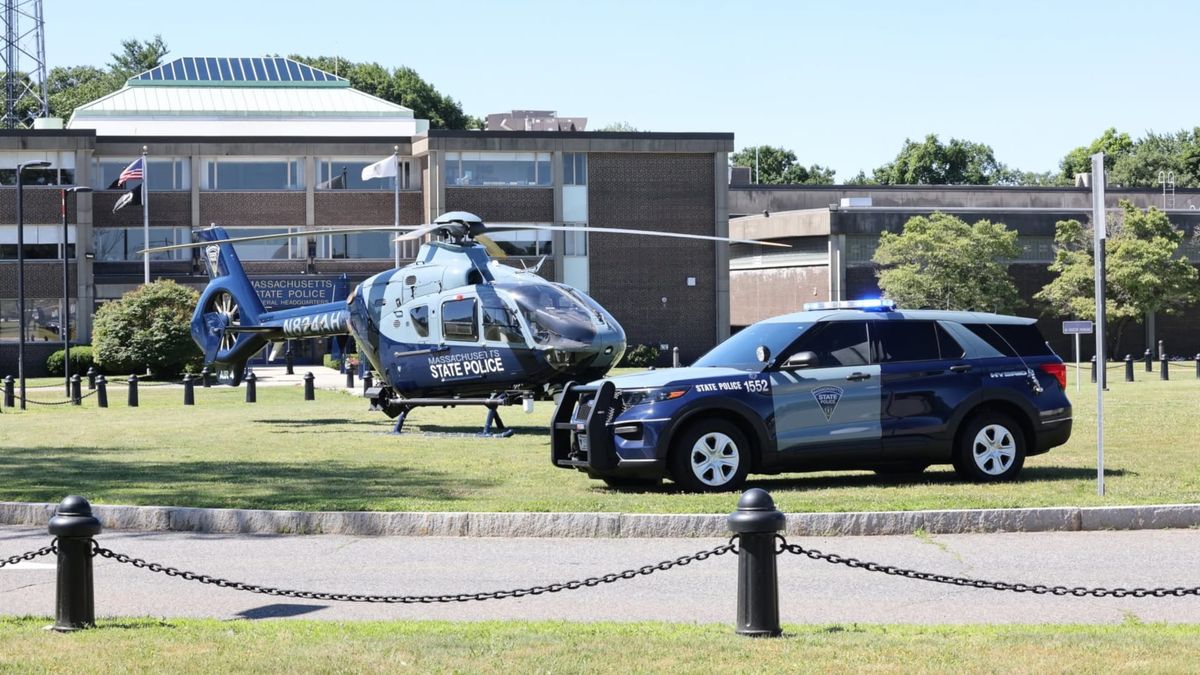
The Massachusetts police oversight board suspended a state trooper’s law-enforcement certification after he was charged with stealing a Bobcat bucket-loader vehicle from a contractor he hired to remove fallen trees from his property in Palmer, records say.
Joseph W. Franklin was charged with two felonies—larceny over $1,200 and intimidating a witness, juror, police officer, or court official—on July 2 after a probable-cause hearing, according to court records. The records do not specify whom Franklin is accused of intimidating. The Massachusetts Peace Officer Standards and Training (POST) Commission suspended Franklin’s certification on July 23, citing unspecified allegations of “criminal conduct,” according to the suspension order.
Franklin was arraigned in Palmer District Court before Judge Michael Mulcahy on July 17, according to court records. Franklin pleaded not guilty to the charges, and the judge released him on personal recognizance. Franklin is scheduled to return to court on August 6 for a motion to dismiss the charges.
The POST suspension order requires Franklin to “immediately surrender … any Agency-issued or government-issued permits, credentials, badges, and equipment associated with service as a law enforcement officer, including but not limited to: any uniform; firearm; assigned cruiser; flashing, rotating, or oscillating blue lights; and use-of-force instruments, such as a taser or oleoresin capsicum spray.”
Franklin’s attorney, James Taylor Brown, did not immediately respond to a voicemail requesting comment.
Franklin allegedly told Palmer police that he paid the contractor $11,000 to remove trees that were knocked down during a severe thunderstorm, according to police reports filed with the court. He told police he was in the process of suing the contractor in Palmer District Court for failing to complete the work and his attorney advised him to hold on to the Bobcat as “collateral,” the records say. Franklin acknowledged that he did not have a lien or court order allowing him to keep the vehicle, according to the records.
Online court records do not list any civil actions involving Franklin or the contractor in Palmer District Court.
Palmer Police Sergeant Jeremy Haley said in his report that he spoke with Franklin and advised the trooper that the contractor had “clearly done work at the property,” that his dispute was a civil matter, and that holding on to the Bobcat was larceny.
“Franklin should … have a basic understanding of the larceny laws as he graduated from the Massachusetts State Police Academy,” Haley wrote. “I know they cover these laws during the classroom portions of the academy as it is required for graduation.”
The Bobcat’s owner told police that he met Franklin through another contractor who was friends with the trooper, according to the records. The owner said he worked with the second contractor to remove trees from the property and they completed the work in April, the records say.
He said that when he returned to the property to retrieve the Bobcat on April 12, Franklin told him the second contractor had taken possession of it, according to the records. The owner alleged that the second contractor refused to tell him where the Bobcat was located and demanded $5,000 for the vehicle’s return, the records say.
Franklin called the Palmer Police Department on May 1 to complain about the work allegedly not being completed, according to the records. Franklin denied having the Bobcat at the time, and police did not see the vehicle on the street where he lived, the records say.
Haley and another officer went to Franklin’s property on May 22, the day after the trooper left police a voicemail acknowledging that he had the Bobcat, according to the records. The officers rang the doorbell but got no response, and they were unable to see into the garage because the windows were covered, the records say.
Haley returned to the police station and called Franklin, explaining that he planned to get a search warrant for the property and that it was in the trooper’s best interest to return the vehicle, according to the records. Franklin said he couldn’t return the Bobcat at that time because he was at work, but Haley said that he was not going to wait for hours, the records say.
Franklin then said he would head home to return the vehicle, according to the records. The trooper asked that the responding officers not activate their body cameras “as it would look bad for him to be removing the Bobcat in uniform,” but Haley said that using the cameras was required by policy, the records say.
An officer waited on the street for a State Police cruiser but did not see one, according to the records. Franklin called the department and said that the Bobcat was now in plain view and the police could retrieve it, the records say.
The officer then responded to the address and saw the Bobcat on the street but did not see a State Police vehicle at the residence, according to the records. Instead, the officer saw a non-police vehicle in the driveway; the officer had seen a woman driving the vehicle down the street shortly before Franklin called the department, the records say.
Thanks for reading! Journalism like this takes a lot of time and effort. If you’d like to keep The Mass Dump running, please consider offering your financial support, either by signing up for a paid subscription to this newsletter below, becoming a Patreon supporter, or sending a tip via PayPal or Venmo. Your support pays for original investigative reporting. A monthly subscription is just $5.
Even if you can’t afford a paid sub, please sign up for a free one to get news about wrongful convictions, police misconduct, public records, and stuff like that—and please share this article on social media.
You can follow me on Bluesky and Mastodon. You can email me at aquemere0@gmail.com.
If you haven’t read it yet, check out this other story I published today:
The Plymouth County District Attorney’s Office created a misconduct disclosure about a Brockton police lieutenant more than two years after a Massachusetts judge found that the officer made “materially false” statements in a sworn affidavit when applying for a search warrant a decade ago.
 Andrew Quemere
That’s all for now.