Northwestern DA’s office spent $12,000 to avoid adopting police transparency policy
DA David Sullivan rejected settlement that would’ve saved taxpayers $12,000 in legal fees if he published police misconduct records online
After a judge ruled in a Mass Dump lawsuit that Northwestern District Attorney David Sullivan’s office cannot block the public from seeing the names and case numbers of police officers who have been charged with crimes, prosecutors rejected a settlement offer that would have saved taxpayers more than $12,000 in legal fees in exchange for adopting a police misconduct transparency policy.
In December, Suffolk County Superior Court Justice Julie Green ruled against the district attorney’s office and ordered it to pay the Dump’s legal fees. However, the Dump told prosecutors it was willing to waive the fees on one condition—that the district attorney’s office would adopt a policy requiring it to post its police misconduct records on its website so the public could more easily access them.
Sullivan’s office rejected the offer—bringing the total cost of the litigation to more than $34,000 of public money. A spokesperson for Sullivan declined to say why.
The lawsuit has its origins in a January 2022 public records request that sought the district attorney’s Brady disclosures about police officers. The Brady documents—named after a 1963 US Supreme Court decision—are used by prosecutors to inform defendants in criminal cases about alleged misconduct by officers testifying against them. Prosecutors are required to make these disclosures so that defendants can challenge the officers’ credibility in court.
Sullivan’s office provided copies of the Brady disclosures but blacked out the names of officers who had been charged with crimes, citing the state’s Criminal Offender Record Information (CORI) law. His office also removed case numbers that were associated with the officers’ criminal cases and with the cases in which the officers were potential witnesses.
After prosecutors refused to release the unredacted records, the Dump filed a June 2023 lawsuit alleging that Sullivan’s office was misapplying the CORI law and acting in bad faith. In response, Sullivan hired a private law firm at taxpayer expense to resist releasing the information.
In a decision on December 30, nearly four years after the Dump first requested the records, Green ruled that the names and case numbers were not protected by the CORI law. However, she ruled that prosecutors did not act in bad faith by withholding the information.
Green noted that the officers’ names and case numbers are listed in court dockets. She said these documents are public records that are available to view at courthouses and any information contained in them is a public record. It did not matter, she said, that the Dump requested this information from the district attorney’s office rather than searching through court records.
“Now that the judgment is final, other district attorneys can follow suit and release similar information, if requested, without fear of violating the CORI statute,” said the Dump’s attorney, Mason Kortz. “That’s a significant step forward for transparency in Massachusetts.”
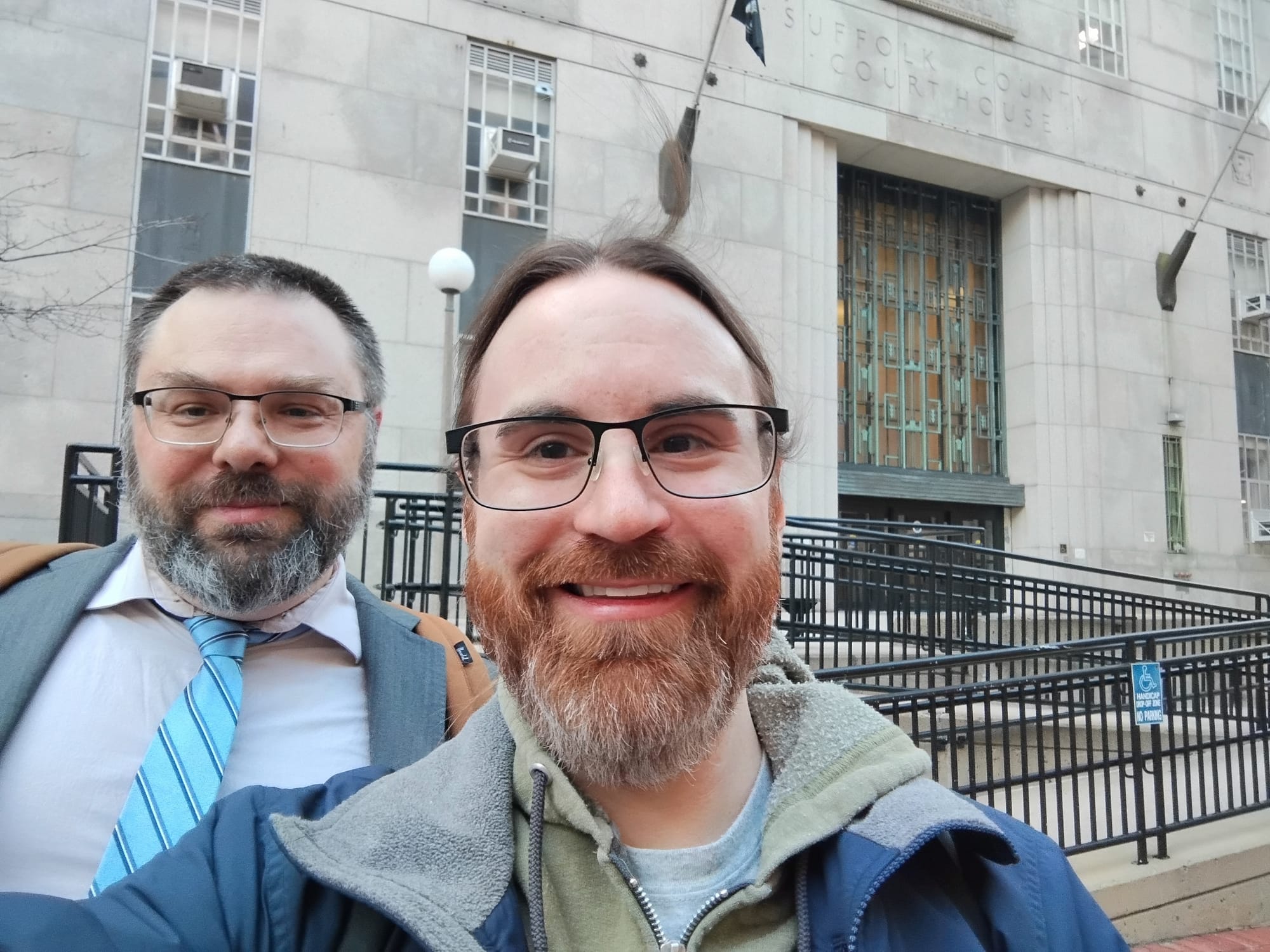
Kortz is a clinical instructor at Harvard Law School’s Cyberlaw Clinic. Students from the clinic helped Kortz prepare the case, giving them “the opportunity to see—and be part of—the evolution of the law,” he said.
On January 21, after the judge issued her decision, Patrick Hanley, a lawyer representing Sullivan’s office, called Kortz to discuss the issue of the Dump’s legal fees.
Hanley said that the district attorney’s office was considering filing a motion asking the judge to reconsider her ruling about the legal fees because prosecutors believed they should not have to pay them, according to Kortz. To resolve the issue, Hanley offered a $7,000 settlement—about 56 percent of what Kortz said the clinic was owed.
In a January 26 email, Kortz rejected the lowball offer, saying the Dump “feels that a full award of fees would be appropriate” and “strongly believes the [Cyberlaw] Clinic deserves to be paid for its work.”
However, Kortz made a counteroffer, saying the Dump was willing to forgo all attorney’s fees if Sullivan’s office “were to take steps to proactively publish information about officers subject to Brady disclosures on its website.” Kortz noted that the Middlesex County District Attorney’s Office already posts this type of information online.
“This proposed settlement would advance the cause of government transparency,” Kortz wrote. “It would also save taxpayers nearly $13,000 as well as the cost of further litigation, which could include additional attorneys’ fees.”
Kortz offered to meet with Sullivan’s office “to discuss specifics of a potential stipulation (for example, what information the website would provide and how often it would be updated).”
However, Hanley wrote back the following day, saying the district attorney’s office was rejecting the offer. He did not explain why.
“My client is inclined to agree to your fee estimate of just under $13,000,” Hanley added.
Sullivan’s office then paid the Dump’s legal fees without filing a motion for reconsideration or appealing.
Kortz said he received a check for $12,480.87 from the district attorney’s office on March 23. Harvard then deposited the check and added the money to the Cyberlaw Clinic’s litigation support fund, he explained.
“The fees received by the Cyberlaw Clinic will allow us to continue supporting journalists, researchers, and other records requesters,” Kortz said.
He added: “Fee shifting also provides an incentive for agencies to comply with records requests, rather than waiting for litigation. It’s unfortunate that, in this case, the incentive was not strong enough to convince the district attorney’s office to adopt a more proactive transparency policy.”
Sullivan’s office was represented by Hanley and another attorney from the Boston-based private law firm Butters Brazilian. The district attorney’s office agreed to pay $350 an hour each for the two attorneys and $75 an hour for the work of clerks and paralegals, according to a July 2023 agreement obtained by making a public records request.
Butters Brazilian charged taxpayers $22,044.01 for its work on the lawsuit, according to invoices released by the district attorney’s office—meaning that despite losing the case, the private law firm was paid over $9,000 more than the clinic that represented the Dump.
Hanley, in addition to being a law partner at Butters Brazilian, is a member of the Massachusetts State Ethics Commission. Governor Maura Healey appointed him to the commission in June 2025, after he began representing Sullivan’s office.
The Butters Brazilian attorneys argued in court documents and oral arguments that it would be illegal and potentially criminal for Sullivan’s office to release the names of police officers who had been charged with crimes.
But after receiving the unredacted Brady records from the district attorney’s office in March, the Dump reported that prosecutors had already published the names of two of the officers and details about their criminal cases in online press releases and other self-laudatory documents.
In one public document, the office used details of an officer’s criminal case to praise the “phenomenal job” done by First Assistant District Attorney Steven Gagne—the prosecutor who signed the agreement with Butters Brazilian and approved the firm’s invoices.
 Andrew Quemere
A spokesperson for Sullivan’s office declined to answer questions about why prosecutors spent tens of thousands of tax dollars fighting to conceal information they had already made public.
“I have never lied, and we’ve been very forthcoming with records,” Sullivan told the Springfield Republican in March, after his office provided the unredacted Brady disclosures.
When the Dump requested the Brady disclosures in January 2022, prosecutors initially blacked out the names of every police officer, whether they had been charged with crimes or faced internal investigations for alleged non-criminal misconduct.
At the time, Sullivan’s office cited the Public Records Law’s privacy exemption—even though this exemption says that it “shall not apply to records related to a law enforcement misconduct investigation.”
It wasn’t until May 2024 when Sullivan’s office agreed to disclose the names of officers who faced internal investigations. The reversal came about only after the Massachusetts Supreme Judicial Court ruled in a separate case that the Bristol County District Attorney’s Office couldn’t invoke the privacy exemption to conceal the names of officers in records related to a misconduct investigation of a fatal police shooting.
Before going to court, the Dump filed three administrative appeals with the state’s supervisor of public records, the transparency watchdog who serves in the Massachusetts Secretary of the Commonwealth’s Office. All three times, the supervisor found that Sullivan’s office had failed to justify redacting the names and case numbers under the privacy exemption or the CORI law.
“While we’re happy with the ruling, it’s important to recognize that the supervisor of records reached the same conclusion in 2022,” Kortz previously said. “This could have been resolved quickly and without spending tens of thousands of dollars of public money if the district attorney’s office had complied with the supervisor’s order back then.”
Thanks for reading! Journalism like this takes a lot of time and effort—especially when it requires going to court to force government agencies to comply with the law. If you’d like to keep The Mass Dump running, please consider offering your financial support, either by signing up for a paid subscription to this newsletter below, becoming a Patreon supporter, or sending a tip via PayPal or Venmo. Your support pays for this aggregation project and original investigative reporting. A monthly subscription is just $5.
Even if you can’t afford a paid sub, please sign up for a free one to get news about wrongful convictions, police misconduct, public records, and stuff like that—and please share this article on social media.
You can follow me on Bluesky and Mastodon. You can email me at aquemere0@gmail.com.
That’s all for now.