Dispatch From A ‘Pinball Lover’s Paradise’ In Massachusetts
Pintastic New England brings pinball to the masses with new and old machines, tournaments, and community
And now for something a little different than what readers of this newsletter might expect. This story was originally published by the Boston Institute for Nonprofit Journalism on April 27, 2026.
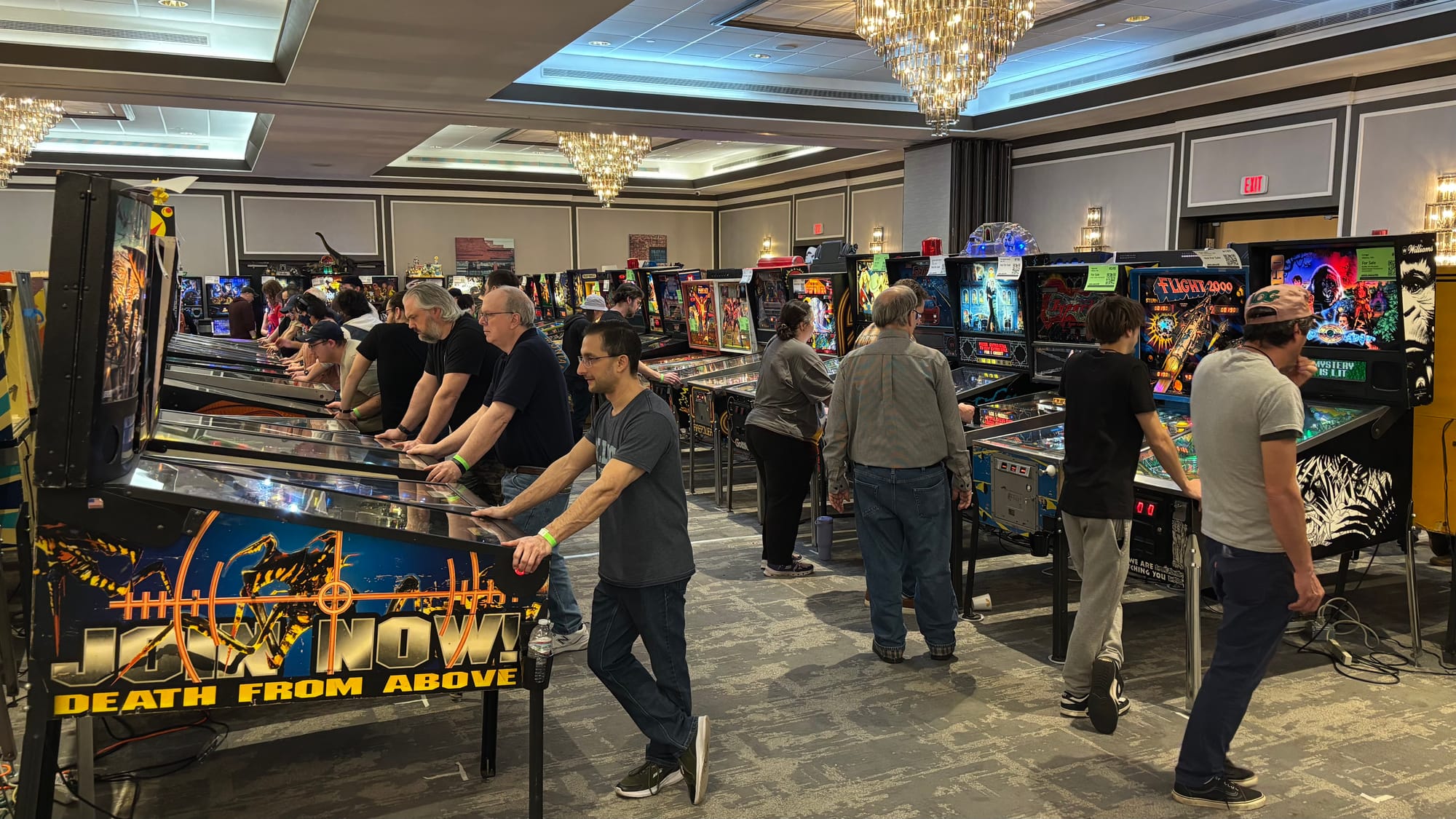
The sounds of countless flippers flipping and silver balls striking bumpers filled the first floor of the Best Western Royal Plaza Hotel in Marlborough, Massachusetts. Over four days, Pintastic New England, which bills itself as “a pinball lover’s paradise,” hosted its 11th annual convention dedicated to the venerable American pastime.
The huge event—which ran from the night of Thursday, April 9, to the afternoon of Sunday, April 12—offered something for pinball fanatics and people just looking for a fun weekend activity.
In an era of ubiquitous touchscreens, pinball offers players a uniquely kinetic and tactile experience. The cabinets vibrate as the balls bounce around under the glass. And the machines are meant to be nudged just so to avoid draining a ball.
While pinball doesn’t come close in popularity to other forms of entertainment, those who partake will discover a lively scene. Pintastic gave people the opportunity to take in everything that scene has to offer in an almost overwhelming fashion. A casual player could, in one or two days, try more pinball machines than they’d seen in their life. Attendees could also learn about the hobby and industry at wide-ranging seminars, compete in tournaments, and meet new people. They could even buy pinball machines if they had the money—and a place to put them.
“I’m always looking for … East Coast people who are working on pinball,” said Pintastic executive David Marston. “Part of what we’re trying to do here is show that there’s a lot going on in pinball right here in New England and the Northeast.”
There were about 225 pinball machines at the convention this year, Marston said. They spanned nearly eight decades, from a 1947 Chicago Coin Play Boy to brand new titles—and even a prerelease version of Yukon Yeti, Turner Pinball’s gold rush-themed game that it expects to release this summer.
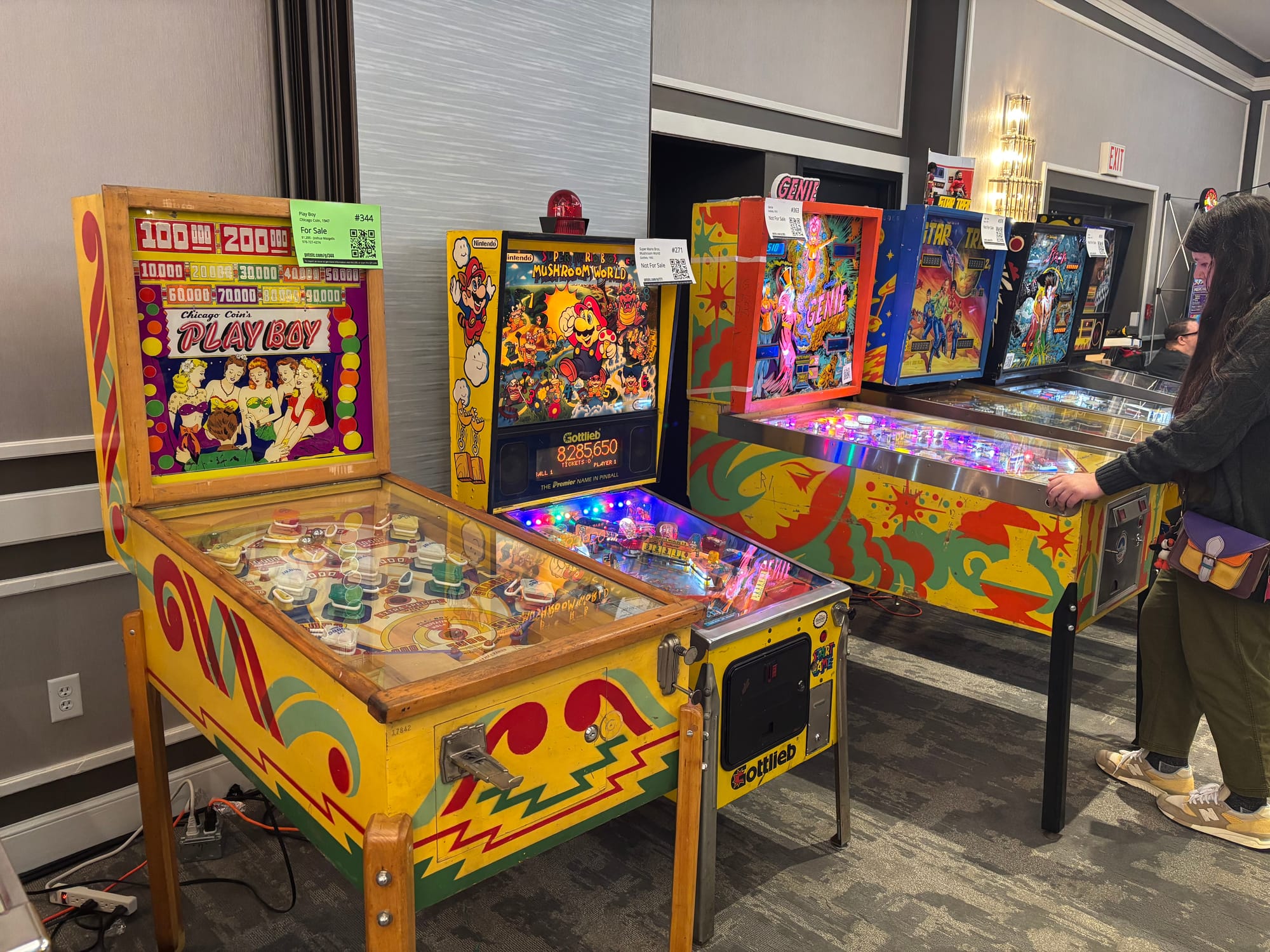
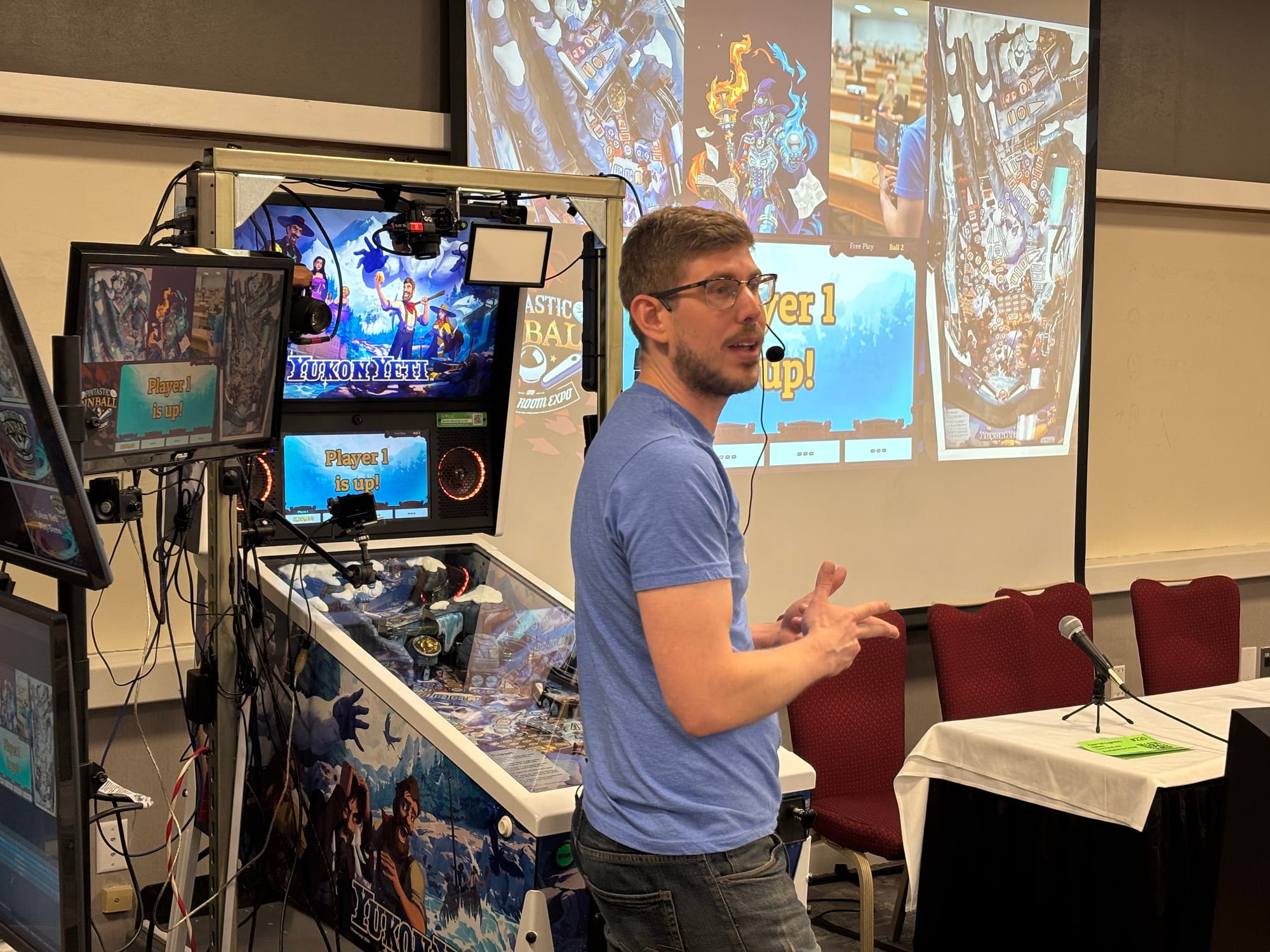
Pintastic featured a huge show room with tons of games and vendors. There were also a number of smaller areas featuring machines supplied by New England pinball organizations like the Western Mass Pinball Club, the Southern NH Pinball Club, the Vermont-based Pinball Co-op, and the all-women-and-nonbinary Boston Belles and Chimes. The games were set to free play, meaning those who paid to enter the convention could try them as many times as they wanted without having to insert money into the machines.
With so many games at their fingertips, players could trace the transformation of pinball tables over time—from relatively simple electromechanical machines to complex contraptions that incorporate computers, multicolored LED lights, animatronics, and magnets.
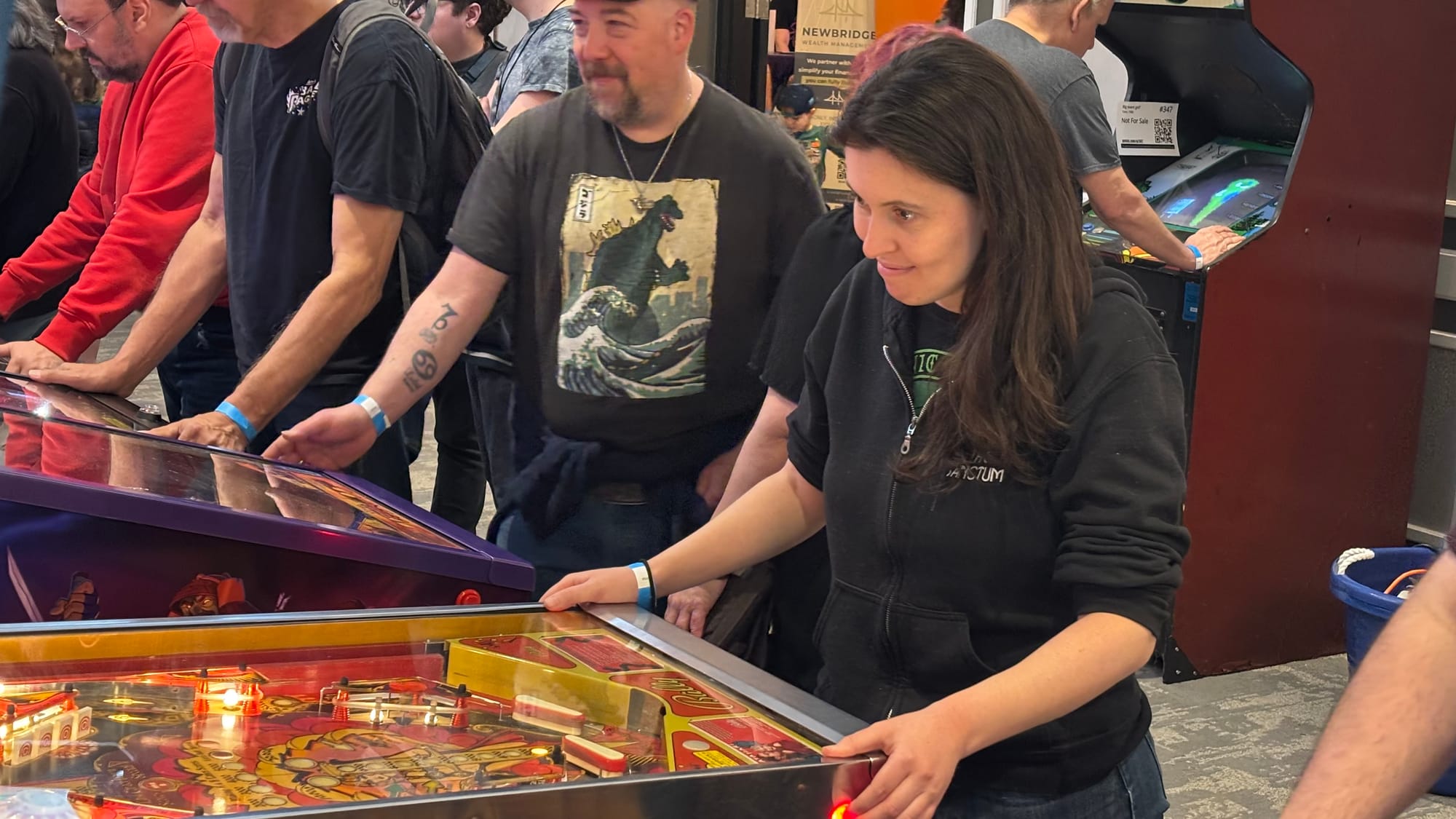
“There’s so much pinball in one place,” said Kate Finegan, who traveled from Connecticut with two friends to spend a Saturday exploring the convention.
Finegan said she’s been playing pinball competitively for a decade and this was her fifth time at Pintastic. She said the convention is the biggest pinball event she’s attended, and she loves that it gives her the chance to play games she doesn’t see elsewhere.
“Something else I appreciate about pinball is all of the artwork within the games,” she said. “Whether they’re new or old, you can find something cool to appreciate about each machine.”
One of the game providers this year was Lonnie Linen, the founder of Arcade Archeology in Queensbury, New York. Linen said that Arcade Archeology is a nonprofit museum that preserves old games—and allows people to play them. He said he keeps games on the floor of the museum even when they are being restored, and patrons enjoy seeing how the work is done.
Linen looks for “unusual games,” he said, noting that he brought several rare titles to the convention—including Bounty Hunter, a 1985 Western-themed game of which only 1,220 were produced. He said his favorite of the bunch was a 1969 Gottlieb Mini Pool, a billiards-themed game.
“I really wanted to focus on the cultural aspect that these games carry, which I feel is sometimes lost in the way that we present [them] today,” Linen said. “Archaeology is the study of human culture through artifacts that we leave behind. These machines are our artifacts.”
Linen said he wants to make sure that “in 50 years, people still understand why we cared so much, why we all came out to Pintastic, why we go to these events and we love these games so much.”
Gotta play ’em all
The most popular new game this year was Stern Pinball’s Pokémon, which was released in February, just in time for the 30th anniversary of the Japanese media juggernaut. There were a number of Pokémon machines at the expo, and they saw constant use.
Terry Tuckey—who works for TNT Amusement, her father’s Pennsylvania-based company that distributes pinball machines (including Stern games)—attended the convention cosplaying as the Pokémon trainer character Misty. Her boyfriend, Greg Howlett, accompanied her dressed as the cartoon’s protagonist, Ash Ketchum. Both said they had fun playing the new game.
“We’ve seen little ones all the way up to seniors [playing it], and everyone enjoys it,” Tuckey said. “It plays very fast. … But [it’s] very self-explanatory.”
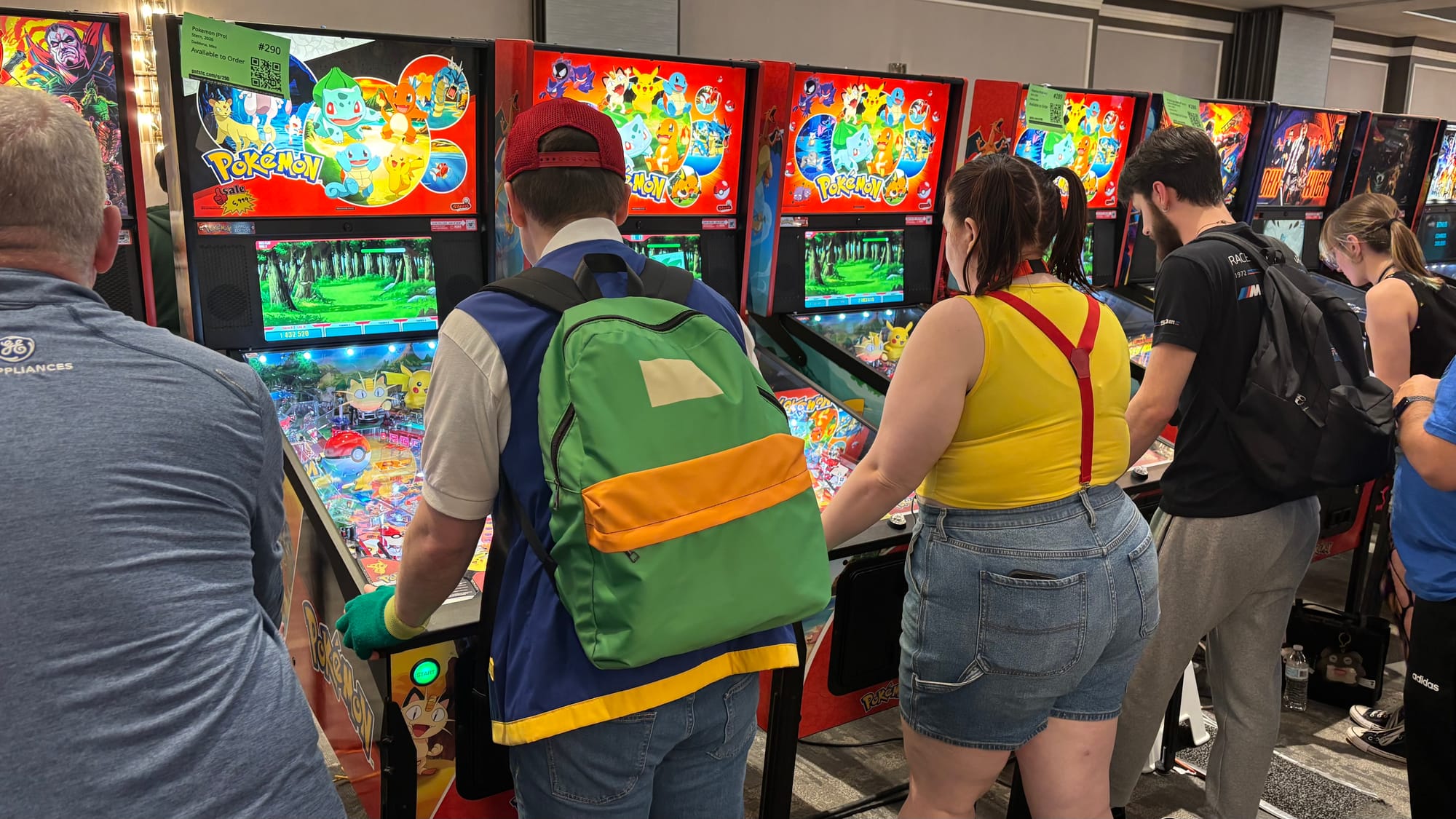
The Pokémon table features a Pikachu figure with an animatronic head and a Team Rocket Meowth hot-air balloon figure that rises and falls. By performing tasks in the game, players can “catch” 182 different Pokémon. As with other Stern games, players can sign up for an online account that automatically tracks their scores and other progress wherever they play.
Finegan, the Connecticut pinball player, said she was most looking forward to trying Barrels of Fun’s Dune machine, which was released in April and is based on the sci-fi film series directed by Denis Villeneuve. After playing Dune, Finegan said she enjoyed the Pain Box mode, which forces the player to operate the flippers with one hand by requiring them to use their other hand to hold down a button in the middle of the machine or lose their ball. She also liked the game’s mechanical sandworm that can magnetically grab the player’s ball and swallow it.
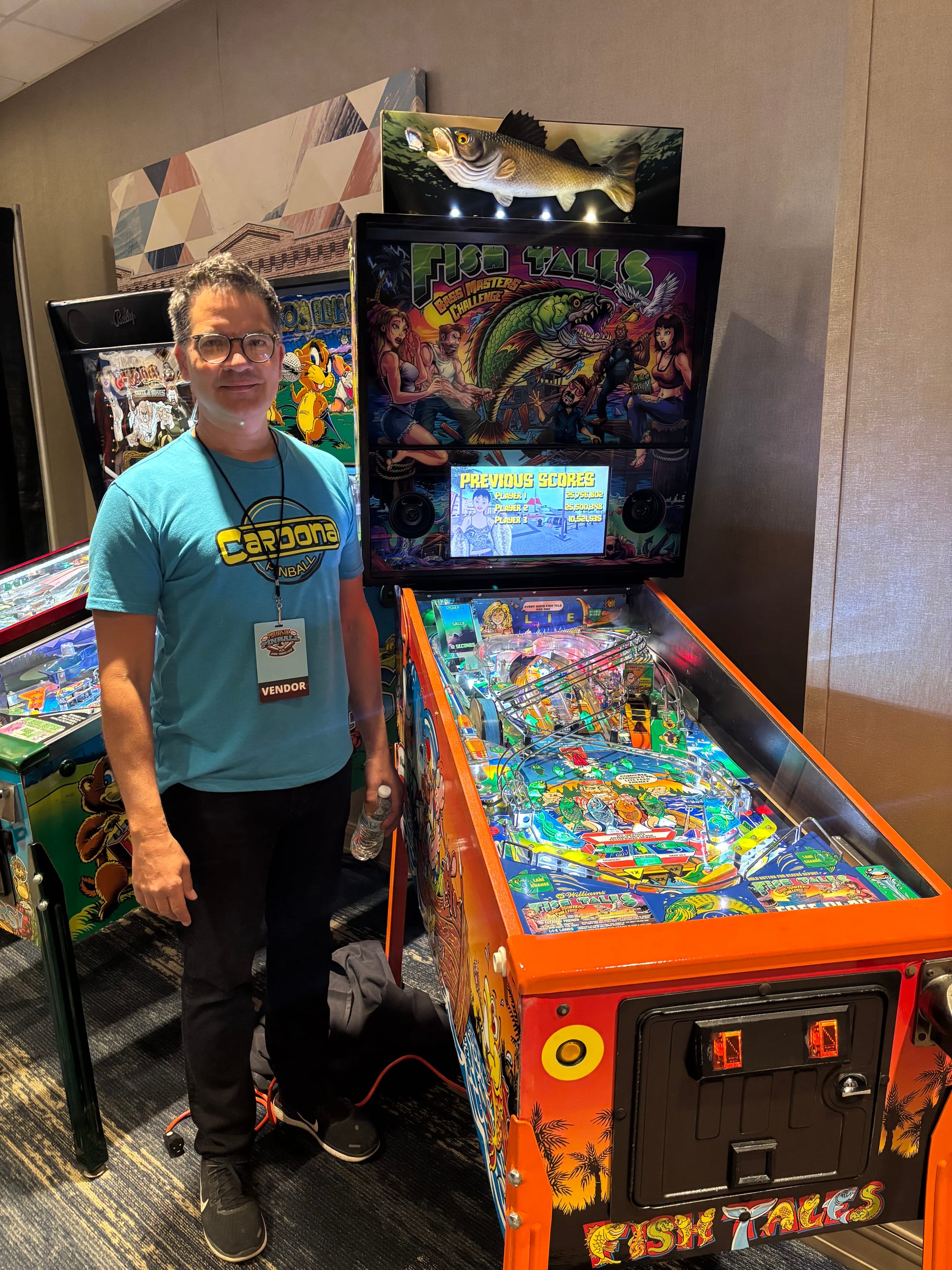
James Cardona, the owner of Cardona Pinball, unveiled his latest product at Pintastic—an upgrade kit for Fish Tales, a 1992 fishing-themed game by Williams. “It’s already a great game,” he said. “So why would we do it? Because I feel like I could make it better.”
Cardona said the kit adds an LCD screen, speakers, new artwork, additional game modes, and five selectable characters that allow players to earn different bonuses. The upgraded version of the game, he added, includes about a dozen licensed songs, including “Barracuda” by Heart.
“That song is iconic to me,” Cardona said.
Eric Meunier, who designed Jersey Jack Pinball’s June 2025 Harry Potter machine, gave a presentation about the making of the game. Meunier said he’s loved the Harry Potter franchise since he picked up the first novel at a book fair in third grade.
“When you are designing a game that you have an extreme amount of passion for, all of the things that could stop you and try to stop you, you keep pushing, you keep going,” he said.
Meunier said that Jersey Jack had pursued the Harry Potter license for about 10 years, but it didn’t become available until the franchise got a new head of licensing who liked pinball. Once the opportunity arose, he said, he had just a week to develop the high-level concepts for the game to pitch to the license holder.
“And that was a caffeine-fueled creativity session,” Meunier said. “I don’t know how much I slept that week, but it was not enough.” He said there’s never enough time when designing a pinball table, but with Harry Potter, they were able to spend a little more than two years designing, manufacturing, and releasing it.
One attendee praised the game but asked Meunier about the controversy surrounding Harry Potter author J.K. Rowling, whose bigoted comments and outspoken support for laws restricting transgender people’s rights have led to backlash from fans and even the stars of the movies her books inspired.
“I love this license, and the stance that the author has is not a stance that I agree with,” Meunier responded. “I had to put that aside when making this game. When talking to friends who are strongly opposed to this license, it’s—I’m not going to let an opinion, an incorrect opinion, change the way I feel about this franchise.”
At a different presentation later that day, Jersey Jack founder Jack Guarnieri encouraged people to be “evangelists for pinball.”
“I don’t want to get mushy, but with everything going on in the world, all the crazy stuff and everything like that, we are sharing something that brings smiles to people and happiness. And that binds us all together. If you’re a red state, blue state, purple state, no state, whatever sexual orientation you feel like having. You might be a camel today, that’s fine,” Guarnieri said, prompting laughter from some in the audience.
Another new game featured at Pintastic was Spooky Pinball’s Beetlejuice, which was released in November and is based on the 1988 Tim Burton comedy/horror film. An inflatable Beetlejuice character stood next to a row of the machines in the main show room, and people were constantly waiting in line for a turn.
Finegan said she tried Beetlejuice for the first time at Pintastic, and her main thought after leaving was how excited she was to play it again.
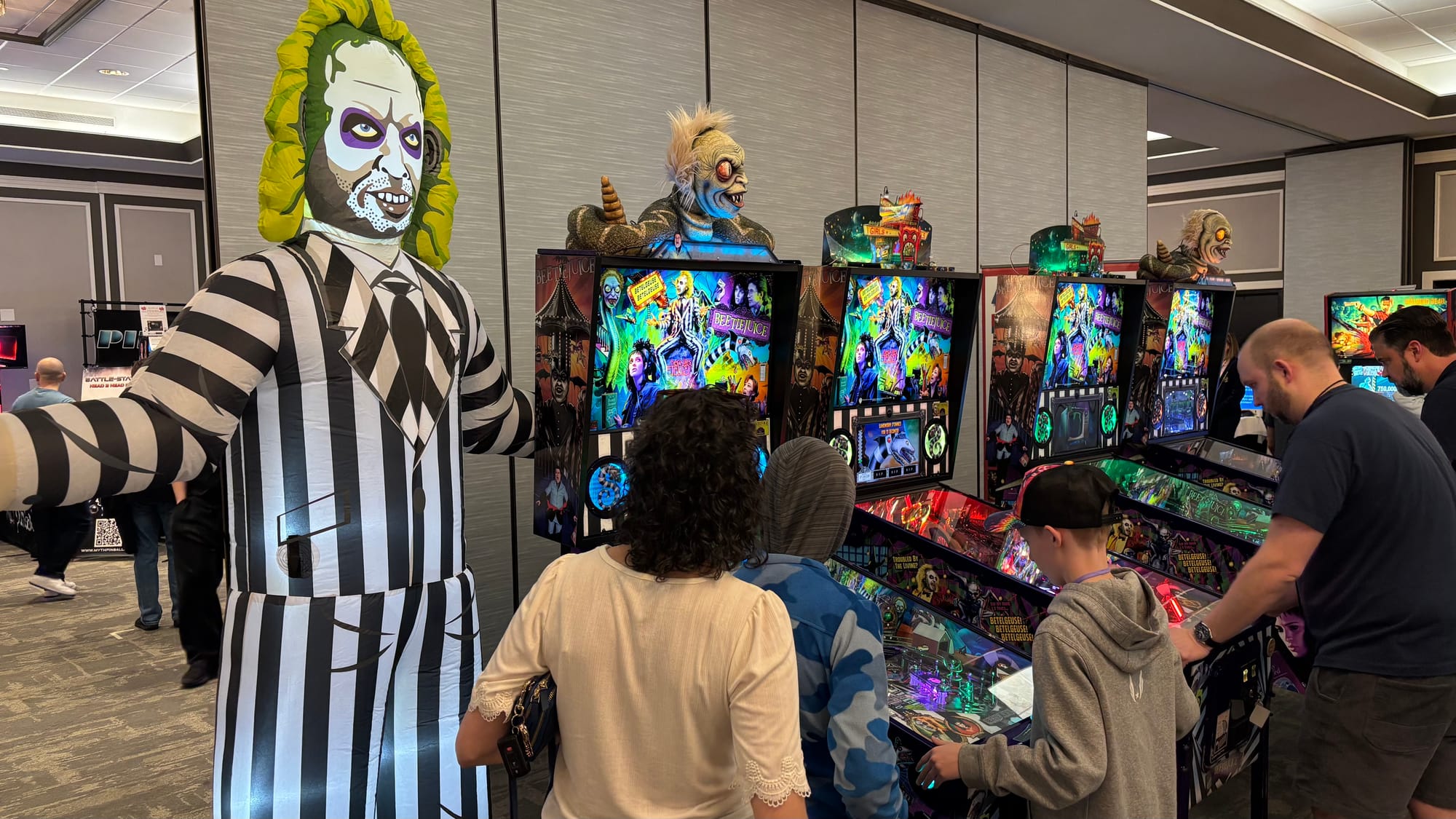
The composer and sound designer for the game, Brady Hearn, said at a presentation that Beetlejuice was one of his favorite movies as a child. Hearn, a New York City-based musician who has worked in TV and film, said he arranged three versions of the main theme from the movie—one for each ball the player gets.
He said he also composed more than 30 original tracks and created the sound effects. Hearn tried to match the style of the music from the movie, which he said was a combination of circus music and “cheesey horror.” In Marlborough, he showed examples of how he synced the music and sound effects with moments in the game, like the release of the multiball.
“I love moments in pinball machines where everything comes together—music, lights, the gameplay, everything starts at the same moment or everything lines up,” he said.
‘Don’t be afraid’—it’s just a homemade pinball machine
While most of the machines featured at Pintastic were commercial products, there was one room—the “Custom Game Showcase”—dedicated entirely to homebrew pinball machines in varying states of completion.
One of the games, based on the Warhammer 40,000 franchise, was playable but did not have any artwork on the playfield. The designer, Aaron Richardt, said he has reached out to his favorite artist from the Warhammer community about working on it.
Another amateur designer, Ryan James Russell, said he rebuilt a worn-out Williams Major League pinball table and was showing it publicly for the first time. Since he was debuting the baseball-themed game in Massachusetts, he decided to base its new look on Fenway Park, the home of the Boston Red Sox.
“I got the same paint color codes from the actual paint that they use at Fenway for the red and the blue,” he said.
Russell showed off a mechanism for spitting out baseball cards, which he said he would eventually integrate into the game. He said he also plans to add the song “Sweet Caroline,” which will play every seventh game.
At a panel discussion about homebrew game development, Sam Hilty brought his custom machine inspired by the British animated series Wallace & Gromit.
“I went to school for game design, so I did a lot of 3D modeling in the style of art and animation,” he said. “And I also thought, like, you know, they’re all sort of like Rube Goldberg-y, so I think it fits.”
Hilty’s machine wasn’t working—but other community members tried to help him get it flipping in front of the audience.
“What we’re showing is, like, very much a part of the homebrew experience,” said FAST Pinball CEO Aaron Davis, who connected Hilty’s machine to a PC to test the electronics. “It’s like, you’re hooking things together, you’ve never done this before, like we’re learning how it works in real time. So this is a very natural process. Don’t be afraid.”
Members of the panel spoke about how helpful the homebrew community has been when they’ve faced challenges.
Richardt said that after modifying one of his pinball tables and bringing it to the convention, he discovered that the three bolts holding the playfield in place had snapped. He started to panic, but community members were able to track down the bolts he needed and helped install them.
“Now my game works correctly, but I didn’t have any of those parts or tools on hand to do it,” he said. “The community stepped in and saved my ass for the show. So thank you guys.”
Featured in one of Pintastic’s other side rooms were completed custom games inspired by the comedy films Happy Gilmore and The Hangover series. Brian Soares of Norton, Massachusetts, said he made the two games by modifying existing pinball tables.
Soares said he did all the engineering and coding. However, he worked with model and TV personality Reby Hardy, who offered creative input and designed the artwork.
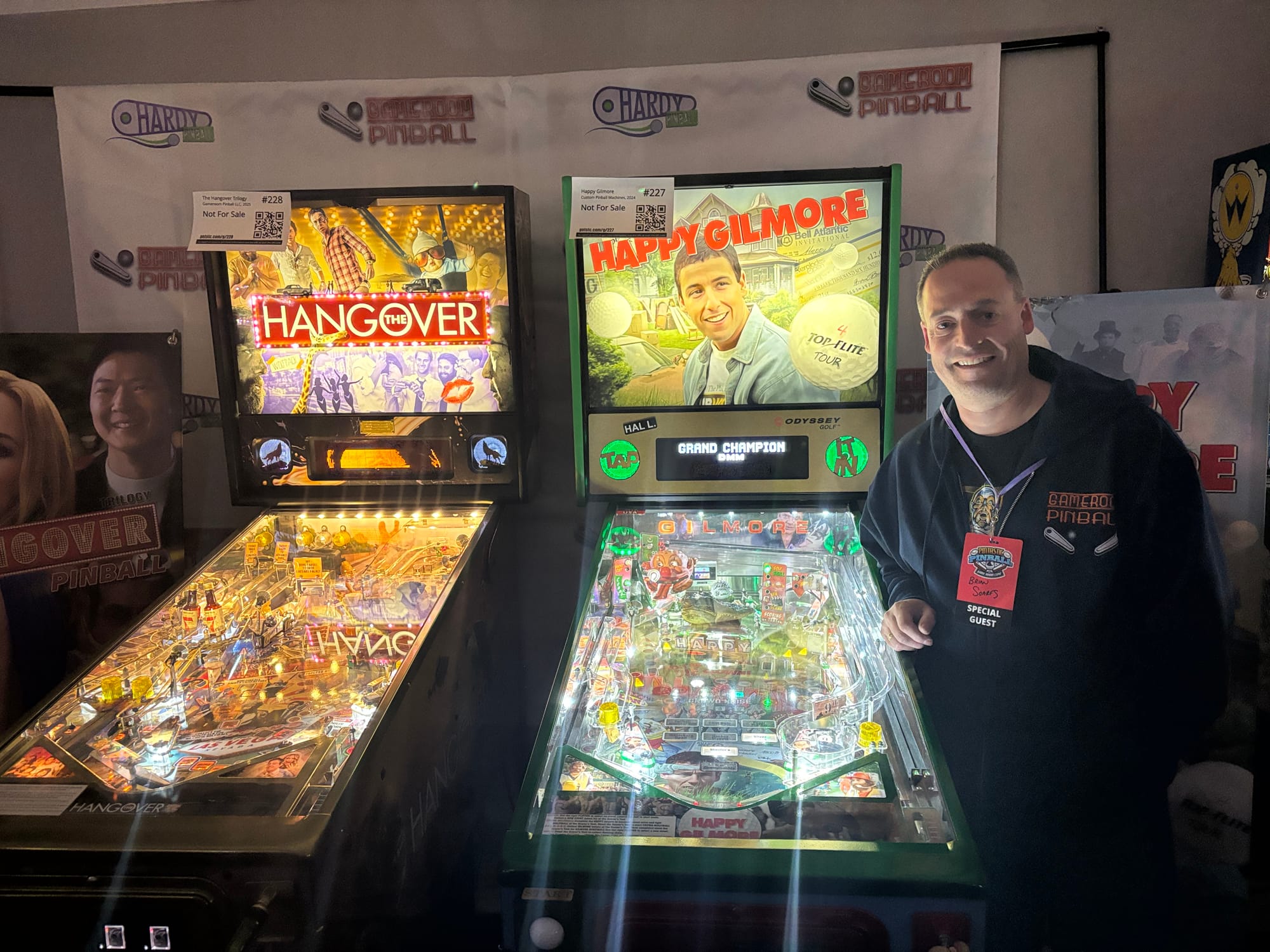
Soares said he works as an engineer but started customizing pinball machines about two decades ago as a hobby, at first working on them for himself, his kids, and friends.
Now, he runs a company called Gameroom Pinball. He said he builds custom pinball machines for high-end clients, including companies that want branded machines for trade shows or employee breakrooms and affluent people who want special pieces to display in their homes.
“I’m kind of like an oddball, I think, in the whole hobby,” he said.
Soares said the Happy Gilmore game—based on the Adam Sandler movie about a wannabe hockey player with an anger-management problem who discovers he has a knack for golf—was originally designed for former NBA player Todd MacCulloch.
“He said he had been following me for years, and he wanted me to do a game, but it had to be something special,” Soares said. “So he’s like, Do you like Adam Sandler? And I said, I love Adam Sandler.”
Soares said he views his custom games as art pieces and usually only makes one of each. But in the case of Happy Gilmore, he decided to make three so he could keep one for himself. He said each Happy Gilmore machine includes a real taxidermied alligator head in reference to the animal Sandler’s character decapitates in the movie.
He said one of his favorite parts of the Hangover machine was inspired by a scene from one of the movies in which the characters discover their friend’s severed finger adorned with a class ring. Soares said a Hollywood prop master designed a rubber finger for him, and he made a replica of the ring.
“I try … to put a lot of exacting detail from the movies into the games,” he said.
‘It just brings so much joy’
Howard Levine said he started playing pinball as a child, when he was “old enough to get on a step stool.” The New York state resident bought his first pinball machine when he was 12 using money he made from a newspaper route. Now, he’s a volunteer board member and fundraiser for a charity that makes pinball tables available to children facing serious illnesses.
According to Levine, Project Pinball was founded in Florida in 2010 by his friend Daniel Spolar after he learned about a Spider-Man game that a family donated to a children’s hospital. The hospital didn’t have the know-how to maintain the machine, so Spolar offered to help.
Since then, the charity has placed 86 pinball tables in children’s hospitals and Ronald McDonald Houses throughout the country, including three in Massachusetts, Levine said. The machines are maintained by a network of volunteer technicians that Levine helps coordinate.
“The impact of going to a dedication where we’re rolling a pinball machine through the hallways of a kids’ hospital and just seeing the reaction of the kids, and families, and staff—just they’re enthralled with it and it just brings so much joy,” Levine said, fighting back tears.
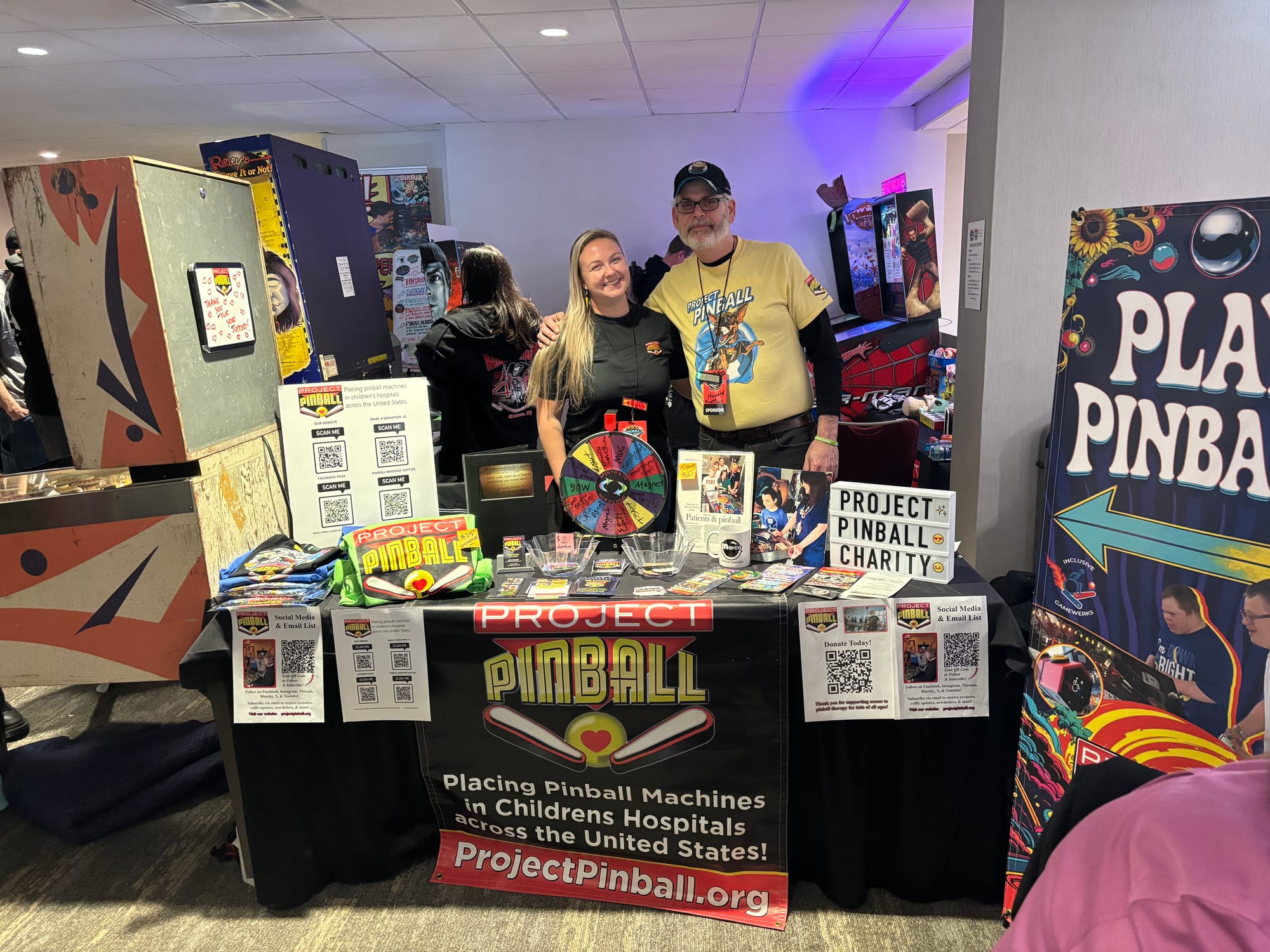
Levine said that years ago, Project Pinball donated a Wizard of Oz machine to Mass General Hospital in Boston. Eventually, they removed it for maintenance and temporarily replaced it with a World Cup Soccer game—but after The Wizard of Oz was fixed, the hospital said it would rather keep the sports title because the children loved it so much.
“They keep that machine on 24/7 in the kids’ playroom,” he said. “So any time a kid wants to step up and play, it’s ready for them.”
The group currently has a fundraiser to put a pinball machine in Boston Children’s Hospital.
Levine said Project Pinball has been at Pintastic every year since it started. He said the convention organizers donate the charity’s floor space.
“It’s a great show and such a supportive community,” he said. “People are very generous. Times are tough, gas is expensive, but our donation box is full.”
Each year at Pintastic, Project Pinball holds a raffle for an older game—this year it was a 2004 Stern Ripley’s Believe It or Not! machine. Levine said the charity sold 347 raffle tickets at $25 a piece, raising $8,675 in addition to the more than $2,000 the group raised from other sources.
Levine said Project Pinball has also been exploring ways to make pinball machines more accessible for people with disabilities.
“Here at Pintastic, we have a machine on short legs, like maybe about 10 inches shorter than a normal pinball leg,” he said. “When you roll up to a normal-height pinball machine [in a wheelchair], it’s not at a great angle. It’s almost hitting you in the chin. So bringing the machine down lower allows somebody to roll up to a pinball machine [and] be able to see it better.”
The group has also started using adaptive pinball controllers, like video-game controllers, large buttons that can be placed on the top of a machine, balls that can be squeezed, and devices that allow a person to play using their head.
“I think we’re up to about six or seven [locations] that have adaptive controllers, but someday it’ll be every location,” Levine said. “It’s really the community developing these devices for people that have various challenges, and then they’re bringing these devices to us.”
‘A beautiful community around this’
Pintastic also featured a dozen pinball tournaments this year, some open to all players and others aimed at women, children, or beginners. There were also “split flipper” tournaments, in which two people would team up—with one player controlling a game’s left flipper and the other controlling the right—as they competed against other teams.
According to Marston, the Pintastic executive, it was the largest number of tournaments ever hosted at the convention.
Many of the competitions were just for fun. But some allowed players to win cash prizes and earn World Pinball Player Rankings (WPPR) points, which the International Flipper Pinball Association (IFPA) uses to rank competitive players from around the world.
The biggest tournament at Pintastic was the three-day Silverball Rumble, which featured 44 qualifying players spread across two divisions.
New Hampshire resident Eric Stone took home the first-place trophy for the A division. Stone, a former TV meteorologist, is currently one of the top competitive pinball players in the world, according to his IFPA ranking. After scoring enough points on a 2024 Spooky Pinball Evil Dead machine to secure his victory over fellow finalist Liam Bradley, Stone threw his hands in the air to celebrate.
Earlier during the convention, Stone ran a seminar about playing better pinball. With the boisterous affect of a broadcaster, he taught Lisa McKale how to improve her score on a 1991 Williams Terminator 2: Judgment Day machine in front of an audience. Stone said players should stop to read the rules before they try a new game so they know the best ways to score points.
“Once you know how to play the game and once you know the rules, … it really elevates your game,” he said.
Stone said learning how to catch the ball on a flipper is a key skill because it gives the player time to think about which shot they want to make.
“I’m all about control,” he said. “I like having the ball on a flipper. I don’t like having the ball moving. Because if the ball’s moving, you have a better chance of losing the ball.”
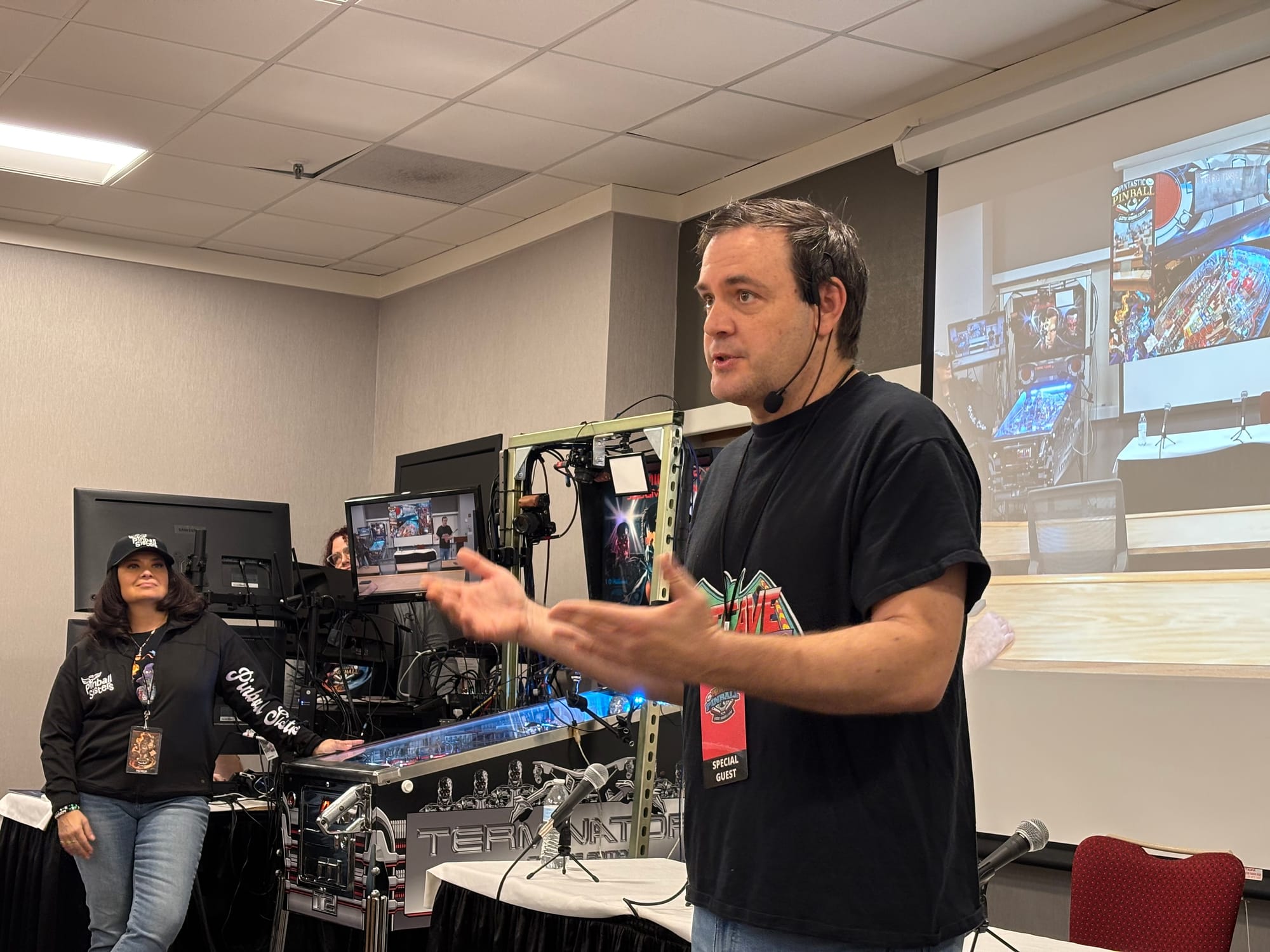
Stone instructed McKale on how to make skill shots and pull off advanced maneuvers like passing the ball from one flipper to the other. By the end of the seminar, McKale managed to get a multiball and earn a jackpot in Terminator 2 as Stone cheered her on.
“You don’t need me anymore,” Stone told her.
Dakota Roundtree-Swain, who lives in the Boston area, said they are new to competitive pinball and this was their first time at Pintastic.
“My first date with [my girlfriend] was in December 2025, and we went and played pinball because she’s been playing competitively for a long time,” Roundtree-Swain said. “I got hooked—both on pinball and her.”
Roundtree-Swain participated in the Friendly Flips Beginner Tournament. They said it was their first large tournament, and although they didn’t do very well, they had a lot of fun.
“I think it’s really meditative,” they said. “You have to be really attuned. … It’s just trying to beat yourself every time.”
They love that pinball can be a solitary or communal activity, and they’ve met a lot of people through the hobby, they said. After participating in the tournament, they’re even more excited about pinball, they said, and they plan to join a league soon.
“There’s just a beautiful community around this,” Roundtree-Swain said.
Marston said next year’s Pintastic will be held from April 8 through 11 at the Best Western in Marlborough, and those interested in attending can sign up for the convention’s newsletter for updates. This reporter recommends bringing earplugs.
This article is syndicated by the MassWire news service of the Boston Institute for Nonprofit Journalism. If you want to see more reporting like this, sign up for BINJ’s free weekly newsletter at binj.news/signup/.
Thanks for reading! If you’d like to keep The Mass Dump running, please consider offering your financial support, either by signing up for a paid subscription to this newsletter below, becoming a Patreon supporter, or sending a tip via PayPal or Venmo. A monthly subscription is just $5.
Even if you can’t afford a paid sub, please sign up for a free one to get news about wrongful convictions, police misconduct, public records, and stuff like that.
While I focus on those topics, I do occasionally enjoy writing about entertainment media. Here’s a story I wrote about a Federal Trade Commission price-fixing investigation of Nintendo using documents obtained from a Freedom of Information Act request:
 Andrew Quemere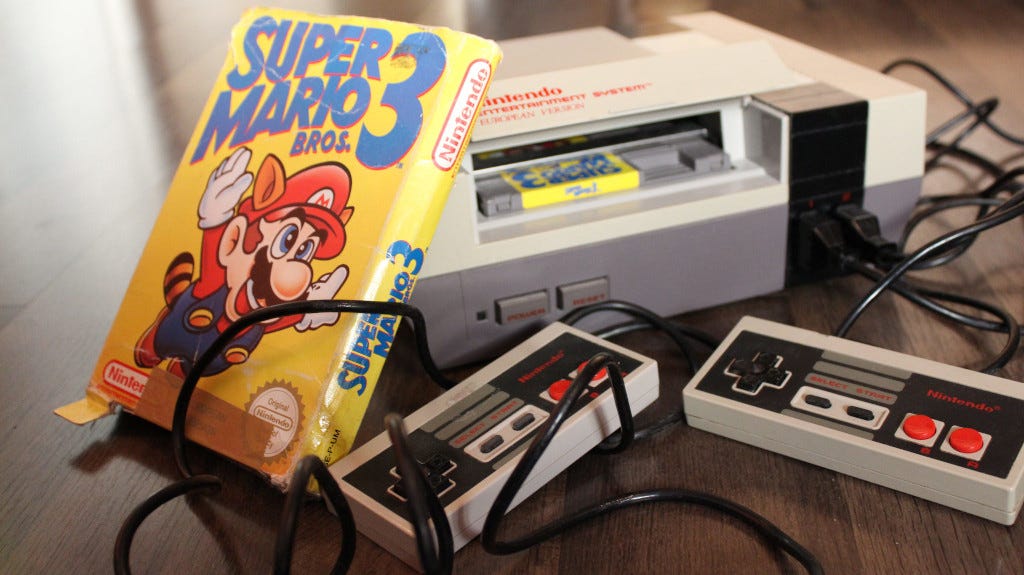
You can follow me on Bluesky and Mastodon. You can email me at aquemere0@gmail.com.
That’s all for now.