Mass law enforcement misconduct news, Aug. 3-9
Judge finally calls out State Police for systematically violating the Public Records Law
Here are the media reports of alleged law enforcement misconduct in Massachusetts that I’ve tracked during the last week.
State and local
Judge finally calls out State Police for systematically violating the Public Records Law
Here’s the biggest news item from last week via MassLive:
A judge found the Massachusetts State Police has engaged in a “pervasive” pattern of violating the state’s public records law for years, setting the stage for potential court-ordered reforms aimed at improving how the agency responds to records requests.
The [July 24] ruling could have implications well beyond the lawsuit itself. Suffolk Superior Court Judge Gillian Feiner concluded the issues were not limited to just the 14 public-records requests from the Committee of Public Counsel Services (CPCS) that were central to this case, but that State Police engaged in “a pervasive informal practice” of violating public-records law.
The problems with the State Police go well beyond CPCS’s 14 public records requests, as the judge noted:
CPCS also pointed to public-records data submitted by State Police to the Secretary of the Commonwealth, arguing MSP failed to respond to the vast majority of all requests it received in 2022, 2023 and 2024.
According to figures cited in the lawsuit and later by Feiner, State Police had the lowest public-records response rate of any Massachusetts state agency during that period. In 2024, the agency reported producing records in just 0.3% of requests and responding within 10 business days in 9.9% of cases, according to the court filings.
I’ve had my share of problems requesting records from the State Police over the years, which I was interviewed about for a Springfield Republican story that was published in March. Here’s what I said:
“It’s not a big ask for such a well-funded agency to simply follow the law,” [Andrew] Quemere said, pointing to the State Police’s half a billion dollar budget. “Especially when they claim their role is law enforcement, at the minimum we should expect law enforcement to follow the law.” …
As a journalist, police records access is an issue in his work, but he thinks the alarm should go beyond the media industry. “I think the wider public needs to be concerned about it,” he said. To him, the State Police’s lack of compliance “speaks to the ideology and culture of police in this country – that they don’t see themselves as accountable to the public or the law even.”
The State Police’s constant failure to respond to public records isn’t really a failure—it’s deliberate. The department leadership does not want to be transparent and knows it can get away with breaking the law, so it does. It’s welcome news that a judge recognized this and wants to do something about it.
Exactly what the judge will do is unclear. She gave CPCS and the State Police 45 days to come up with a proposed injunction before she decides what to do next. I predict the State Police will try to avoid making any substantive changes to the way they do business. Hopefully the judge won’t stand for that, will insist on a robust set of reforms, and will monitor the agency to ensure that it actually adopts them.
It’s important to understand that public records requests aren’t just about idle curiosity. Some of the wrongful-conviction cases I’ve written about involve people who spent decades in prison after police and prosecutors hid records with critical exculpatory evidence. Ideally, police and prosecutors would turn over all exculpatory evidence in the discovery process, like they’re legally required to do. But often they don’t, and lawyers and private investigators need to use other means, including making public records requests, to uncover that information.
In this case, CPCS sued the State Police because public defenders were looking for records that could potentially help their clients. That one government agency had to sue another for records necessary to defend people against criminal charges is a major failure of the legal system. It’s a huge scandal that Beacon Hill should be called on to address.
The State Police are to blame for ignoring records requests, but lawmakers are to blame for letting them get away with it for so long. Ultimately, we need more structural reforms to the Public Records Law to hold law-breaking agencies like the State Police accountable.
Massachusetts, to its credit, does have an administrative appeals process for records requests. If an agency doesn’t respond to your request, refuses to release records, or tries to charge an excessive fee, you can send an appeal to the Public Records Division of the Secretary of the Commonwealth’s Office. The Public Records Division is overseen by the supervisor of public records, whose legal staff review the appeals and order the agencies to follow the law.
But there’s a major flaw in this system: The supervisor of public records cannot sue agencies that refuse to comply with these rulings. Instead, the supervisor must send the decisions to the Massachusetts Attorney General’s Office, which does have the power to bring lawsuits—but almost never does. The lack of enforcement means that agencies like the State Police can, and often do, blow off the supervisor’s orders.
This broken system is why I had to track down a lawyer and sue the Northwestern District Attorney’s Office for records documenting police misconduct even after the supervisor of records sided with me three times.
Although I was able to do it, it’s quite difficult to find a lawyer who will help with a public records case. In 2016, the state legislature updated the Public Records Law so that judges can order agencies to pay the legal fees of people who bring successful public records lawsuits. But because these suits take months or even years, the possibility of getting paid at the end of the process provides little incentive for lawyers to get involved.
The system will never be perfect, but the most important thing lawmakers could do to fix it is to remove the enforcement power for the Public Records Law from the Attorney General’s Office, grant it to the supervisor of public records, and give the supervisor enough resources to make use of it.
As I told NBC10 when I was interviewed about this subject in 2024, “The supervisor of public records has to have the ability to just take these agencies to court, to sue them, and to force them to comply instead of just having this system where they can’t do anything.”
Here’s my 2024 appearance on NBC10 Boston:
Here are the rest of the state and local stories from last week:
- “Brockton Mayor Moises Rodrigues has sued Massachusetts for negligence in a May 2025 wreck with a State Police trooper. The crash put Rodrigues into the hospital and, according to the lawsuit, he continues to be ‘partially disabled’ as a result. A State Police report said Trooper Augustine K. Moore’s inattention and failure to yield right-of-way contributed to the wreck.” (Enterprise; paywalled)
- “Lawyers for Civil Rights is suing the Boston Police Department and the Suffolk County district attorney’s office for withholding police footage that allegedly shows an officer fatally shoot a Dorchester man. The nonprofit group said its lawyers have repeatedly attempted and failed to obtain body camera and dashboard camera footage that allegedly shows Officer Nicholas O’Malley’s lethal exchange with Stephenson King Jr. in March.” (WBUR)
- “A Fall River Police Department K-9 officer who has been on leave since 2024 is set to avoid a verdict for weapons and domestic violence charges after reaching a plea deal. In the agreement made on July 28, prosecutors recommended that 34-year-old Marc Correia remain on pretrial probation until Sept. 1.” (Herald News)
- “The Department of Correction is refusing to reveal the names of the inmates who received payouts from a $6 million class-action lawsuit, the state’s largest settlement [in 2025].” (Boston Herald)
- “The Massachusetts medical examiner who initially ruled Sandra Birchmore’s death a suicide is set to explain why she did so, and why she recently changed that finding, at the upcoming federal trial of the former [Stoughton police] officer accused of killing her [Matthew Farwell], according to a court document that lays out the prosecution’s case in great detail.” (NBC10 Boston)
- “The Department of Justice has closed its investigation into the city of Worcester after a federal investigation previously found the police department engaged in ‘outrageous government conduct,’ ‘excessive force,’ and ‘sexual misconduct’ by officers, the city said [on August 7].” (Boston 25 News)
Bill Shaner has some commentary about the DOJ closing its Worcester case over at Worcester Sucks.
 Bill Shaner
Federal
- “A Boston federal judge [on August 6] ordered ICE to release a Kenyan man it had grabbed and put in a cell four months after the judge had ordered him freed after ICE had grabbed him and put him in a cell.” (Universal Hub)
Other news
Governor Healey signs bill limiting warrantless ICE arrests (WBUR)
Gov. Maura Healey signed legislation [on August 5] that she and lawmakers say provides the strongest immigrant protections in the country.
The new law, known as the PROTECT Act, arose as a top priority for lawmakers and the governor amid intensified immigration law enforcement efforts led by President Trump. The law expands protections against warrantless civil immigration arrests at courthouses as well as public schools, childcare centers and healthcare facilities.
It’s important to understand that this law won’t have any impact on one of the biggest factors that allows ICE agents to act with impunity in Massachusetts—the cooperation of state and local officials. This law will not ban the Plymouth County Sheriff’s Office from holding people in jail on behalf of ICE. So cases like the ones in the previous story about the Kenyan man who was illegally detained for months at the Plymouth County jail will continue to happen constantly. The Massachusetts Department of Correction will also continue turning people over to ICE.
I’ve previously written about Maura Healey’s outspoken support for state collaboration with ICE here:
 Andrew Quemere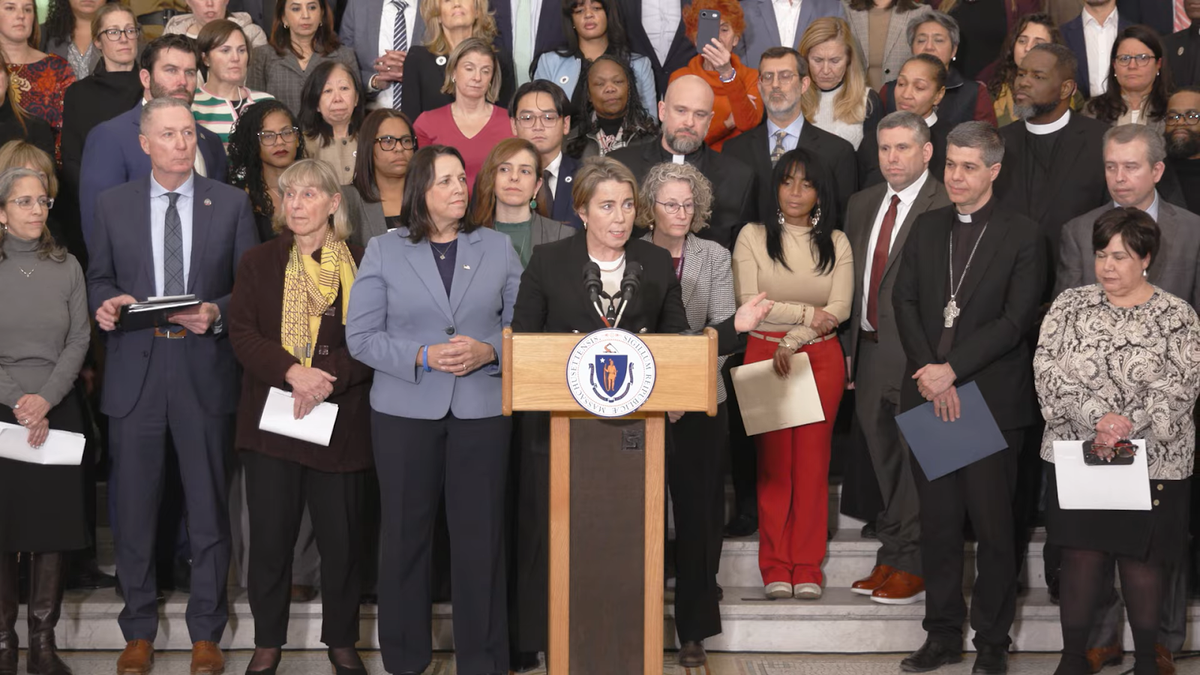
ICE detention causing mental-health crisis among immigrant community (GBH)
“Immigrant families are facing an unprecedented mental health crisis due to detention. Barriers to getting help are structural and cultural, including lack of access to health insurance that covers behavioral health; the cost of appointments; a shortage of clinicians and those that understand the layers of trauma experienced by immigrants; personal hesitation; and cultural stigma.”
These barriers not only affect the detained themselves, but their partners and their children. The Harvard T.H. Chan School of Public Health and the Leah Zallman Center for Immigrant Health Research published a report in March reviewing the range of services available to immigrants, finding some community-led and clinical resources. But a gap remained.
“Despite this foundation of community-led and clinical resources, the landscape remains siloed, under-resourced, and without the durable funding needed to sustain and connect its many strengths,” the report reads.
Couple’s sex-trafficking convictions vacated after judge tried to give gift to victim (Telegram & Gazette)
A Boston federal judge [on July 20] vacated the 18-year sentences of a Worcester couple convicted of sex trafficking following revelations the Worcester trial judge tried to give a gift to the victim at sentencing.
Moises and Kiersten Soto have not been released, but have been returned to Massachusetts for detention pending a hearing on a new trial, records show.
Supreme Judicial Court vacates woman’s murder conviction (WBUR)
A Brockton mother convicted of killing her two sons should get a new trial because the jury did not have access to her entire troubling psychiatric history, the state’s highest court ruled [on August 6]. …
The jury did not have access to thousands of pages of medical records collected over four years while [Latarsha] Sanders was awaiting trial. Doctors found she suffered from paranoia and schizophrenia that was “undetected and untreated for decades.” Trial Judge William F. Sullivan had ruled those records inadmissible, so the jury never saw them.
Police union leader asks judge to force This Week in Worcester publisher to reveal confidential sources (Telegram & Gazette)
A judge Thursday, Aug. 6, heard arguments about whether a local news outlet being sued for defamation by a police union leader can be forced to disclose its confidential sources during an initial phase of the case.”
Worcester Superior Court Judge Gillian Feiner indicated she was not inclined to force the outlet, This Week in Worcester, to disclose sources during initial sworn depositions, though it was unclear whether she would also grant the publication a more sweeping restriction it has requested.
Massachusetts author releases book about how to get better at pinball

On a completely different note, I recently covered a local author’s book-launch event for the pinball news site Kineticist:
Tasker Smith has been playing competitive pinball since joining the New England Pinball League about eight or nine years ago. But the Wayland, Massachusetts, native said his love of the game dates back 48 years, when a friend’s father brought home and fixed up a 1968 Bally Dixieland pinball machine.
“I remember him … tinkering around, trying to understand what it was that was working or not working,” Smith said. “I remember seeing a switch flicker, and it seemed like an important insight. … And I’m probably overstating that in my own mind. For whatever reason, it really drew me into it, and I felt really connected to this machine and to the process.”
Smith said watching the broken game come to life was a magical experience.
“As kids, we just played the hell out of that game,” he said.
Nearly five decades and many rounds of pinball later, Smith has learned a lot about how to play better — and now he’s sharing his advice in a new hardcover volume, Pinball: A Quest for Mastery, published by Schiffer Books. Smith discussed the book with his friend and fellow competitive pinball player, Marc Patenaude, during a release event at the Center for the Arts in Natick, Massachusetts, on July 28.
“It’s a beautiful documentation of how to play pinball, how to get better, how to understand it, how to look at the game differently,” Patenaude said.
Read the rest of this article here:
NEW at @kineticist.com: After five decades of playing pinball, Tasker Smith has learned a lot about how to play better — and now he's sharing his advice in a new hardcover volume, Pinball: A Quest for Mastery, published by Schiffer Books.
— Andrew Quemere (@andrewqmr.bsky.social) August 3, 2026 at 6:57 PM
[image or embed]
Thanks for reading! If you’d like to keep The Mass Dump running, please consider offering your financial support, either by signing up for a paid subscription to this newsletter below, becoming a Patreon supporter, or sending a tip via PayPal or Venmo. Your support pays for this aggregation project and original investigative reporting. A monthly subscription is just $5.
Even if you can’t afford a paid sub, please sign up for a free one to get news about wrongful convictions, police misconduct, public records, and stuff like that—and please share this article on social media.
You can follow me on Bluesky and Mastodon. You can email me at aquemere0@gmail.com.
Is Ed Markey in the Epstein files? A 2015 email says a lobbyist tied to Epstein briefed Markey on the case of a Senegalese politician who was Epstein’s friend. But there’s no evidence Markey worked with Epstein or knew of his involvement. politifact.com/factchecks/2...
— PolitiFact (@politifact.bsky.social) August 7, 2026 at 7:26 PM
[image or embed]
The author of the Democratic National Committee's 2024 election "autopsy" confirmed an Axios report that he concluded the war in Gaza hurt Kamala Harris politically — and that he'd privately shared that assessment with a pro-Palestinian group.
— Axios (@axios.com) August 6, 2026 at 7:12 PM
[image or embed]
That’s all for now.