“Your boy is an exoneree”: Prosecutors drop charge for 1993 Boston murder
Stephen Pina spent 28 years in prison for a murder he said he did not commit
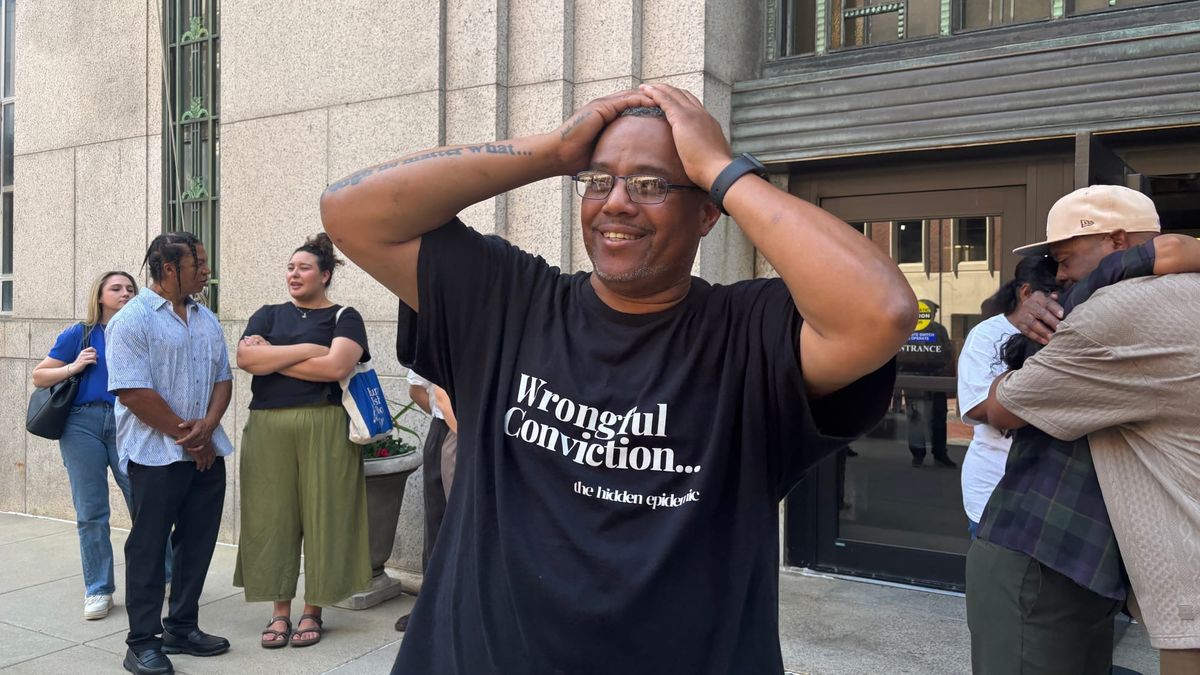
It took less than two minutes for a judge to close the first-degree murder case against Stephen Pina. But the brief hearing on August 13 at Suffolk County Superior Court in Boston was the culmination of Pina’s decades-long fight to clear his name.
“Since October 6, 1993, the day I turned myself in, till today has been 32 years, 10 months, and seven days,” Pina told his supporters outside the courtroom as he fought back tears. “I’ve been waiting to be vindicated and to be an exoneree. Your boy is an exoneree.”
In 1996, a judge sentenced Pina to life without parole after a jury convicted him of murdering Keith Robinson. But in March 2022, after Pina had spent 28 years in prison, Suffolk County Superior Court Justice Peter Krupp suspended his sentence and freed him, citing exculpatory evidence that police and prosecutors had withheld during the trial. Krupp then overturned Pina’s conviction in February 2025. The Suffolk County District Attorney’s Office appealed, but the Massachusetts Supreme Judicial Court upheld Krupp’s ruling in a July 28 decision, leading prosecutors to drop the charges two weeks later.
A spokesperson for the district attorney’s office declined to comment.
There was no physical, photographic, or video evidence tying Pina to the crime, according to the Supreme Judicial Court’s decision. Instead, the case hinged on two now-deceased eyewitnesses who identified Pina as the man who shot Robinson on Horadan Way in the Mission Hill section of Boston on February 26, 1993.
However, evidence uncovered by Pina pointed to another possible suspect and showed that one of the eyewitnesses had been hospitalized for psychiatric conditions that affected the reliability of her identification. Furthermore, test results Pina obtained in 2018 excluded him as the person whose DNA was on a revolver that police found in a snowbank near the scene of the crime and believed to be the murder weapon.
One of the two eyewitnesses said that he was buying heroin from Robinson on the evening of the murder. The witness said he saw the perpetrator approach, grab Robinson by his collar or lapel, and shoot him. Police showed him a photo array, and he selected a picture of Pina but said he “was maybe about sixty percent sure.”
A second eyewitness said she had known Pina for a year and a half to two years, lived across from him in the Mission Hill housing development, and had been buying drugs from him for a couple of months before the shooting.
The witness said that on February 26, she asked Robinson for drugs but he did not have the kind she wanted. While on the street, she saw a “maroonish color car” pull up “really fast.” She testified that there were three people in the car, one of whom was Pina, and he got out and argued with Robinson. She said that Pina returned to the car, retrieved a gun, walked toward Robinson, and shot him.
The witness did not speak with police about what she saw until her friend was killed in an unrelated case. A detective showed her a photo array on April 18, 1993, nearly two months after Robinson’s murder, but she did not identify anyone as the person she saw. It wasn’t until police showed her a second photo array in September 1993, more than six months after the murder, that she identified Pina. She testified that she was high on crack cocaine when she viewed one of the photo arrays but couldn’t remember which one.
The witness was being treated at Taunton State Hospital, a psychiatric facility, when she testified at Pina’s 1996 trial. But prosecutors did not reveal this information to Pina at the time. Records obtained by Pina years after he was convicted showed that the woman had been admitted to medical facilities for psychiatric hospitalization nine other times prior to the trial and had been diagnosed with a mixed personality disorder with borderline and antisocial features.
A psychologist who testified as an expert witness during a 2022 post-conviction hearing for Pina said that the woman’s psychiatric conditions were risk factors for a faulty identification, noting that people with borderline personality disorder have a heightened risk of suggestibility.
The use of eyewitness identifications in court has come under significant scrutiny since 1989, when a judge first overturned a conviction on the basis that DNA evidence exonerated the defendant. Scientific research has shown that eyewitness identifications are highly prone to error. Faulty eyewitness identifications were a contributing factor in 27 percent of known wrongful convictions since 1989, according to data collected by the National Registry of Exonerations.
During Pina’s trial, his attorney tried to introduce evidence that a man had stolen the revolver police believed to be the murder weapon from his father before the shooting, had possession of the gun in late February 1993, and that a friend of the man also had access to the weapon. However, the trial judge did not allow the attorney to cross-examine a Boston detective about this, finding the possibility of the man’s involvement in the murder to be too speculative.
However, police reports Pina obtained through a public records request years after he was convicted provided new evidence of a possible link between the murder and the man who allegedly stole the revolver.
The reports revealed that on the night of Robinson’s murder, three men committed an armed carjacking near the location of the murder. The stolen vehicle was a maroon sedan like the one the second eyewitness said was involved in the murder. Two weeks after the carjacking, police located the stolen vehicle. Inside, they found two men, one of whom was the man who had allegedly stolen the revolver. Krupp wrote that the description of the other man police found in the stolen vehicle was similar to that of the shooter and that his booking photo “[bore] a fairly close resemblance” to Pina.
The man who had allegedly stolen the revolver had a scar on the right side of his forehead when police found him in the stolen vehicle. This was significant because on the evening of the murder, two Boston Housing Authority police officers had spoken with a man who was bleeding from a wound near his right eye and said he had been robbed. The robbery victim declined to provide his name, and when the officers asked him whether he wanted to pursue the matter in court, he allegedly said, “No, I’ll take care of it myself.”
However, the man did point to another man he said was the robber, and the two officers observed the alleged robber enter an apartment building. The officers’ descriptions of the alleged robber were consistent with Robinson. The two officers responded to the scene of the murder, and one said in a report that he believed the victim was the alleged robber while the other said she was sure the victim was a different person.
Pina’s trial attorney raised the possibility of a connection between the robbery and the murder but did not have the information about the carjacking to further support the possibility they were linked.
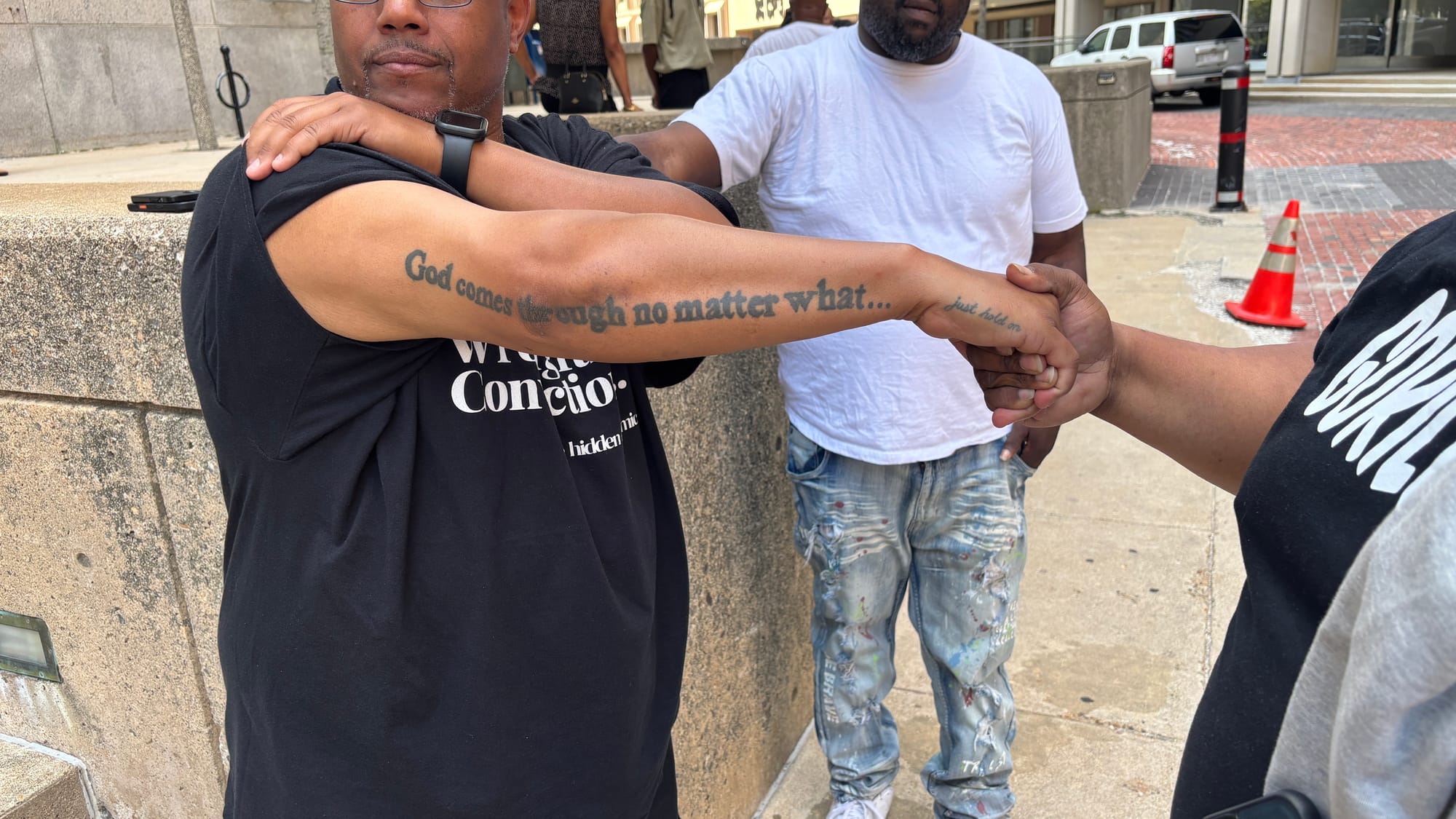
On August 13, dozens of Pina’s supporters packed the benches in a ninth-floor courtroom in Boston. Pina wore a black t-shirt, black pants, and black sneakers. A tattoo was visible on his right arm, stretching from above his elbow to the side of his hand. “God comes through no matter what... just hold on,” it said.
At the hearing, Suffolk County Assistant District Attorney Ian MacLean told Superior Court Justice Joshua Wall that prosecutors had dropped the charges against Pina before the hearing.
MacLean said that the district attorney’s office had consulted with and notified the victim’s family about the decision. He said that the two eyewitnesses who identified Pina at trial were now deceased and prosecutors could no longer sustain their burden of proof.
“The case is now closed,” the judge said.
Pina’s supporters clapped and cheered. He turned to face them, smiled, and raised his fists in the air.
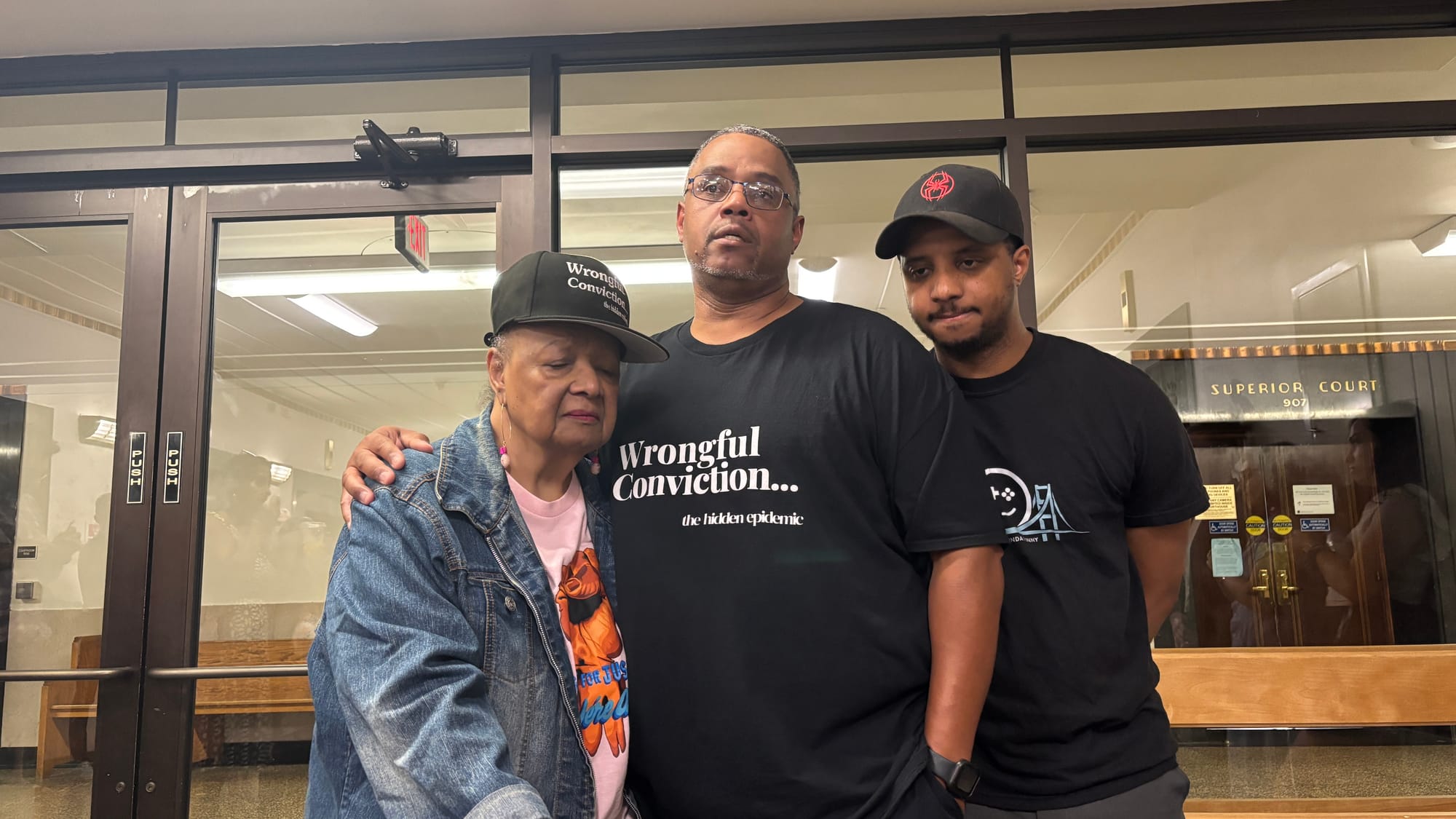
Outside the courtroom, Pina spoke to the crowd and embraced several other Black men whose Boston murder convictions had been thrown out by judges, including Raymond Gaines, Sean Ellis, and Rickey “FuQuan” McGee. Then he hugged his son and his mother as tears filled his eyes.
“Justice was not done today, even though I’m home,” he said. “Keith Robinson[’s] family did not get justice because the Commonwealth back in 1993 did not do their job right. They have let this family believe that I’m the one who took their loved one’s life. I’m not that person.”
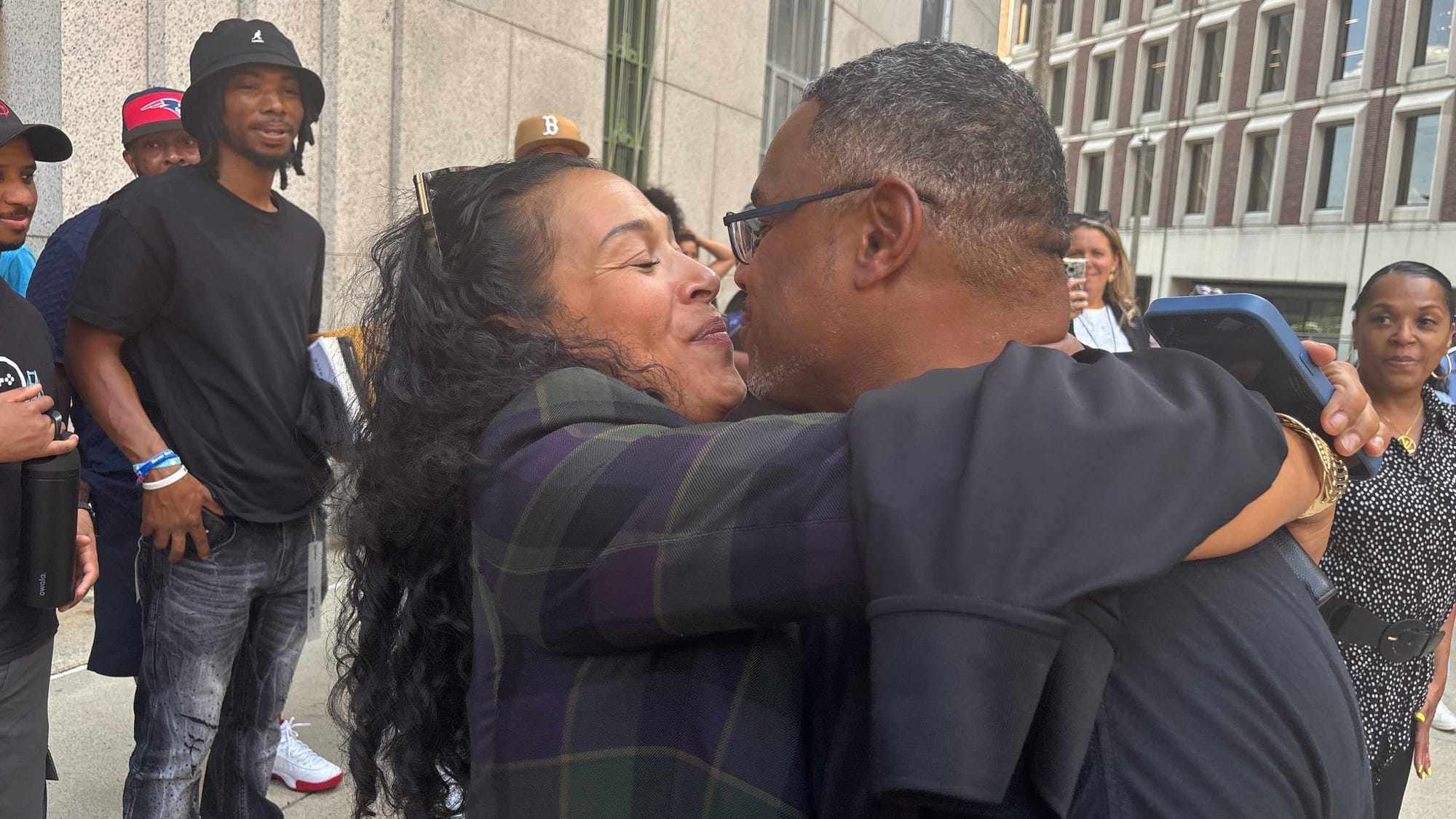
After a court officer asked the group to keep it down, they moved outside. In front of the courthouse, Pina hugged and kissed his partner, Madeline Sanabria.
Sanabria, who refers to herself as Pina’s “lady,” said she met him through Facebook Dating about six months after he was released from prison.
“We weren’t looking to be in a relationship with anyone,” she said. “We were walking buddies. We would walk every day for a mile or two in different places, and it just evolved from there.”
Sanabria said she didn’t realize what a serious problem wrongful convictions were until she met Pina and several other people who were wrongfully convicted in Suffolk County.
“When you learn about it, you can’t unlearn it,” she said. “And when you see it, you can’t unsee it.”
Pina’s mother, Josephine Pina, said she was glad her son was free.
“This is bad,” she said. “Thirty-something years for him to be free from that unjust conviction. … That was wrong. And they know they’re wrong.”
Pina’s son, Stephen Pina, Jr., said his father went to prison the month before he was born.
“I feel relieved,” he said. “It’s good to finally have the decision. … We don’t have to deal with it anymore. We can just move on with life and just live.”
Jill Tessier, one of Stephen Pina’s attorneys, said his case is an example of why prosecutors need to have transparent discovery procedures.
“I imagine that there’s many other people [for whom] there might be some slip of paper sitting somewhere in a box that can make all the difference in overturning their convictions,” she said.
Rachael Rollins, who served as the Suffolk County district attorney from January 2019 to January 2022, appeared while the group was outside the courthouse and hugged Pina and his mother.
Rollins said it was her discovery policies that allowed Pina to finally access the evidence he needed to get his conviction overturned.
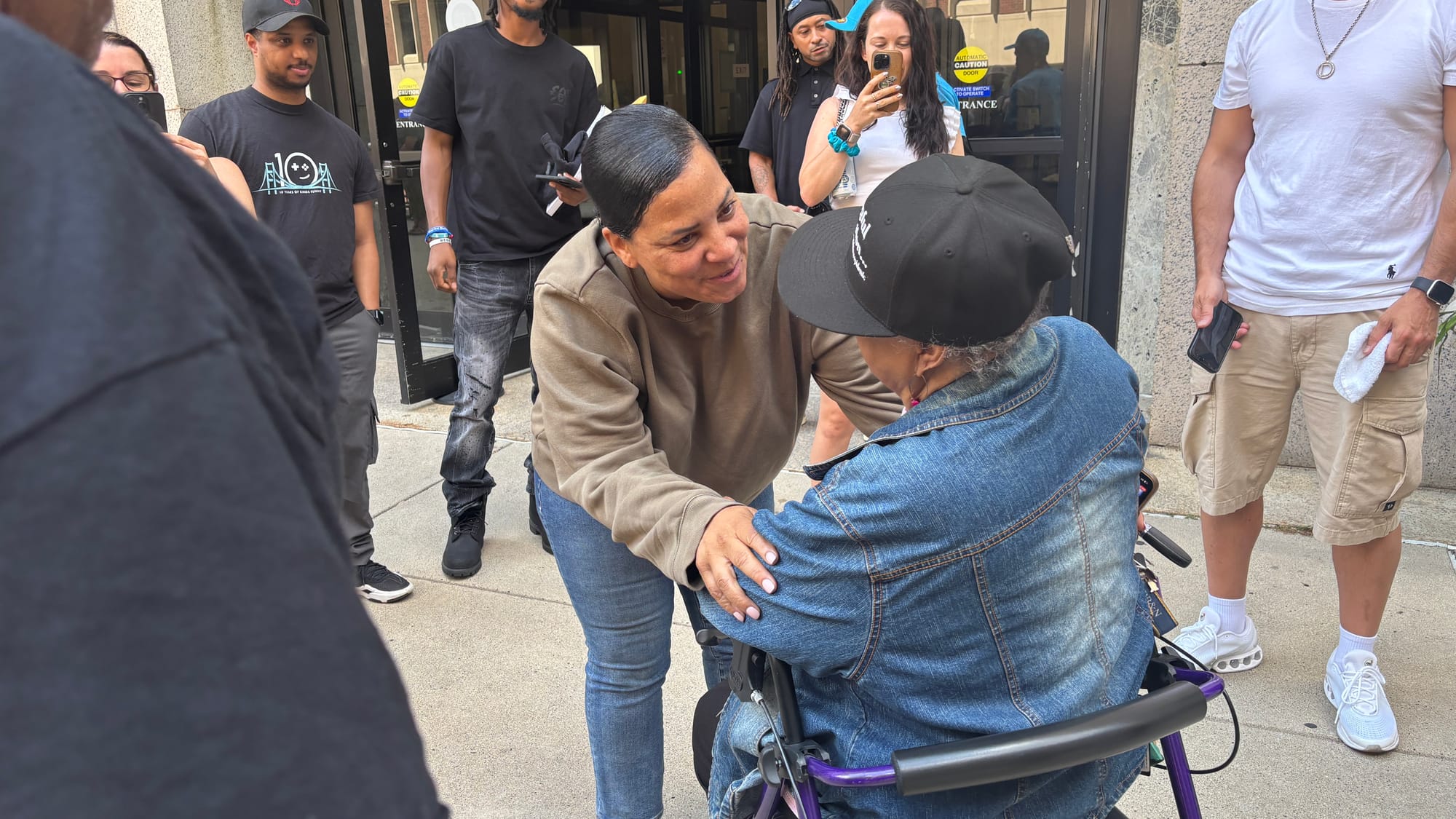
Rollins criticized the current district attorney, Kevin Hayden, who said on GBH in March 2022 that he would support whatever Krupp decided in the case but then appealed the judge’s decision.
“This DA lied to Steve Pina,” Rollins said. “But justice doesn’t care about liars. It cares about justice.”
Rollins, who is currently running against Hayden for Suffolk County district attorney in the Democratic primary, has also faced scrutiny over her ethics. Rollins served as the US Attorney for Massachusetts under President Joe Biden from January 2022 to May 2023, resigning after an inspector general report found she accepted gifts, leaked information to sabotage Hayden’s chances of being elected district attorney in 2022, and lied to investigators. In the current election, she has been accused of submitting fraudulent signatures with her nomination papers.
However, during her three-year stint as district attorney, Rollins’ policies helped secure the freedom of numerous, mostly Black incarcerated men who maintained they did not commit the crimes of which they were convicted.
Pina told the crowd that his birthday is September 1, the day of the primary.
“The only thing I want for my birthday is for y’all to vote for Rachael Rollins, man,” he said. “That’s it. I don’t want no parties. I don’t want no gifts.”
Pina said that after the Supreme Judicial Court upheld the decision that overturned his conviction, he felt a thousand pounds lighter. But now that the case was closed, he felt a million pounds lighter.
“I don’t have to report to probation no more,” he said. I don’t have to come to court no more, unless I’m doing court support. … But for me, it’s all said and done. So I feel great.”
Pina said that when he’s spoken to groups, he would introduce himself as Commonwealth vs. Stephen Pina.
“Now I’m just Stephen Pina,” he said.
As the crowd died down, Pina called his sister, who was in California and planned to visit him but couldn’t make it to Boston in time for the hearing.
“You’re looking at an exonerated man, sis,” he told her.
She told Pina that she loved him.
Pina said he had no idea what he was going to do after leaving court.
“I’ll just spend time with my mother and my son at my house,” he said. “Just relax a little bit, you know what I’m saying?”
Thanks for reading! Journalism like this takes a lot of time and effort. If you’d like to keep The Mass Dump running, please consider offering your financial support, either by signing up for a paid subscription to this newsletter below, becoming a Patreon supporter, or sending a tip via PayPal or Venmo. Your support pays for original investigative reporting. A monthly subscription is just $5.
Even if you can’t afford a paid sub, please sign up for a free one to get news about wrongful convictions, police misconduct, public records, and stuff like that—and please share this article on social media.
You can follow me on Bluesky and Mastodon. You can email me at aquemere0@gmail.com.
That’s all for now.