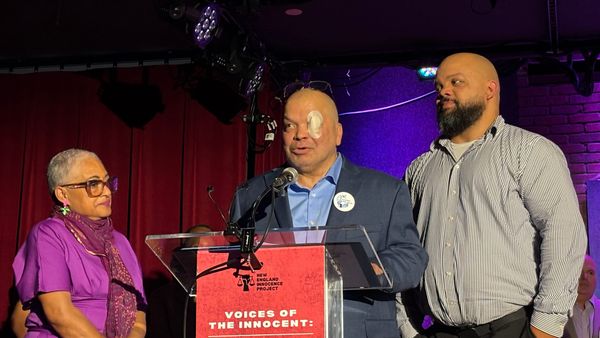
Innocence group asks court to unseal records about Brockton police lieutenant’s “materially false” statements
The New England Innocence Project is asking a judge to unseal records related to a drug case that was overturned due to false statements by a Brockton police lieutenant
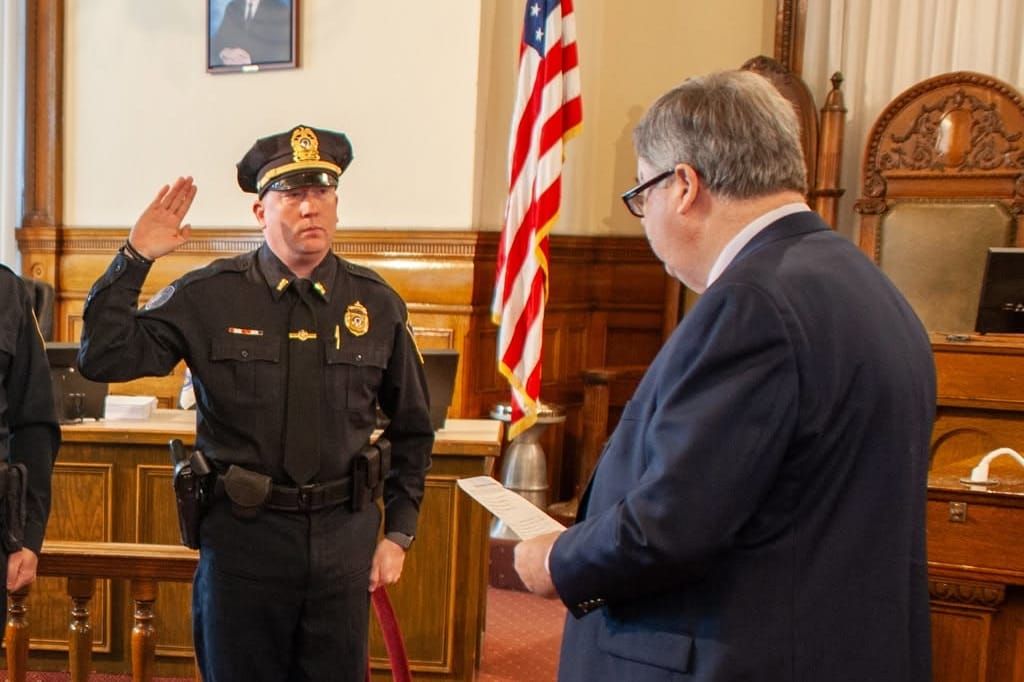
The New England Innocence Project on July 6 filed a lawsuit asking a judge to unseal records related to a drug case the Massachusetts Appeals Court recently overturned after the lead investigator, a Brockton police detective who was later promoted to lieutenant, made “materially false” statements when applying for a search warrant a decade ago.
Plymouth County jurors convicted Allah Mallory of trafficking heroin and cocaine along with firearms charges in 2019. A judge sentenced Mallory to 16 to 18 years in prison.
But according to the Appeals Court’s April 21 decision, Brockton Police Lieutenant Matthew Graham included false information in a sworn affidavit when he applied for a warrant to search the apartment where officers seized evidence in 2016. Graham wrote that another detective was present when a confidential informant bought heroin from the Brockton apartment even though records showed the second officer could not have been there at the time, the decision says.
The Appeals Court also set aside Mallory’s firearms convictions for unrelated reasons in a separate April 21 ruling.
The Plymouth County District Attorney’s Office dropped the charges against Mallory on May 20, according to court records.
According to the New England Innocence Project’s lawsuit, the Plymouth County Superior Court judge who presided over Mallory’s case issued a protective order for information that would identify the confidential informant in March 2023. The court sealed numerous records related to Mallory’s efforts to obtain a new trial in their entirety, including most of the briefings filed by attorneys, at least four hearing transcripts, and the judge’s rulings.
“The records bear on the scope of official misconduct by [Lieutenant] Graham and others directly or indirectly involved in presenting false statements for the purpose of obtaining a search warrant,” the lawsuit says.
The lawsuit alleges that the judge failed to hold a required hearing before issuing the protective order and also failed to issue a ruling after Mallory’s post-conviction attorney sought to clarify the order’s scope.
Even if there was a valid reason for issuing the protective order at the time, the lawsuit alleges, there is no longer good cause for maintaining it. The court must release the records with minimal redactions for information that could identify the informant, such as his name, address, birthdate, phone number, and physical description, the lawsuit says.
In a statement, New England Innocence Project executive director Radha Natarajan said, “We are doing what the prosecutors should have done years ago: Bringing to light all evidence of misconduct in this case so that others who may be impacted are aware and so that there can be an investigation into the true scope of the misconduct.”
The lawsuit says that Mallory, who is not represented by the New England Innocence Project, supports releasing the records “so that journalists can better report on the police falsehoods that were instrumental to his conviction and decade behind bars.”
No attorney currently representing Mallory could immediately be located to ask for comment.
The lawsuit names as defendants the Clerk of Courts for Plymouth County, the Plymouth County District Attorney’s Office, the Massachusetts Attorney General’s Office, and Mallory, all of whom must be included since they are interested parties.
When Graham applied for the warrant in April 2016, the officer wrote in an affidavit that he arranged three controlled drug buys at a Brockton apartment building, court records say. Each time, the confidential informant would call Mallory in the presence of Graham and a second officer, order heroin, and enter the apartment to buy the drugs using money Graham provided, according to the affidavit.
Graham said that the other officer present for the third controlled buy was Brockton Detective Brian Donahue.
However, after Mallory was found guilty, his post-conviction attorney obtained time sheets for Graham and Donahue. The time sheets in conjunction with Mallory’s phone records showed that on the day of the alleged third controlled buy, he did not receive any calls during the four-hour period when the two detectives’ work schedules overlapped.
After holding a hearing related to the time-sheet evidence, Plymouth County Superior Court Justice Mark Gildea ruled in December 2023 that Graham had included “materially false” statements in the affidavit by saying that Donahue was present. Gildea, the same judge who presided over Mallory’s trial, wrote that Graham “was, at a minimum, reckless” by including the false statements.
Gildea ruled that the information about the alleged third controlled buy should not have been included in the affidavit. And in a September 2024 decision, the judge found that this meant the warrant was stale when police executed it because of how much time had passed since the alleged second controlled buy.
However, Gildea rejected Mallory’s bid for a new trial.
In Massachusetts, a defendant may obtain a new trial either by presenting important evidence that was not available at the time of the original trial or by showing that their trial lawyer was unusually ineffective.
Gildea ruled that Mallory’s trial lawyer was not ineffective by not seeking out the officers’ time sheets. But the judge also found that the time sheets were not newly discovered evidence because the trial lawyer could have sought them out. He also concluded that there was no evidence Graham’s statements were “knowingly” or “intentionally” false, writing that the officer’s statements could have been due to “inadvertent error.”
The Appeals Court reversed Gildea’s decision, finding that the time sheets were newly discovered evidence. The Appeals Court ruled that the warrant was invalid and the evidence obtained from the search must be suppressed, entitling Mallory to a new trial.
Brockton Police Chief Brenda Perez promoted Graham to lieutenant in April 2024, four months after Gildea ruled that the officer had included false information in the affidavit, according to city council meeting minutes.
Neither the Brockton Police Department nor Graham responded to emailed questions.
In response to a Mass Dump records request, Plymouth County Assistant District Attorney Karen Palumbo said on July 1 that prosecutors do not have any Brady disclosures related to Graham.
Prosecutors are required to provide defendants with Brady disclosures—which are named after a 1963 US Supreme Court decision—about alleged misconduct by officers testifying against them so that defendants can challenge the officers’ credibility in court.
A spokesperson for the district attorney’s office did not respond to emailed questions, including whether prosecutors are conducting a review to determine whether Graham’s conduct impacted other criminal cases.
The district attorney’s office says on its website that it maintains a “Brady Database” with information about police misconduct, including “judicial findings that specifically call into question an officer’s credibility as a witness.”
Palumbo did not provide the Brady Database in response to the records request. Palumbo said that the request lacked specificity because it “[did] not define or limit which records” the Dump was seeking.
Palumbo has not yet responded to a July 1 follow-up message pointing out that the district attorney’s office identifies the document by this name on its website.
On the morning of July 9, the Dump filed an administrative appeal with the state’s supervisor of public records, the transparency watchdog who serves in the Massachusetts Secretary of the Commonwealth’s Office, arguing the request sufficiently identified the document.
The district attorney’s office provided a Brady disclosure related to Donahue, although it does not mention the Mallory case.
The disclosure includes a copy of a federal judge’s 2013 ruling in a civil rights lawsuit, which found that Donahue unlawfully entered a Cape Verdean family’s home. The judge also found that several Brockton officers used excessive force when arresting members of the family but that the family made no excessive-force allegations against Donahue.
The district attorney’s office redacted information from the ruling even though it is a public court record that is readily available online in unredacted form.
The Dump has also identified two court rulings that found Donahue conducted illegal searches, neither of which are mentioned in the disclosure.
In 2016, the Massachusetts Supreme Judicial Court ruled that Donahue and another Brockton officer illegally strip searched a man in public by pulling back his shorts and underwear and shining a flashlight on his buttocks. And in 2019, the Massachusetts Appeals Court found that Donahue and another Brockton officer unlawfully searched the passenger compartment in a man’s vehicle.
The Brockton Police Department has not yet responded to June 17 requests for Graham and Donahue’s internal affairs records, even though the state’s Public Records Law requires it to respond within 10 business days. The Dump filed administrative appeals challenging the lack of response on the morning of July 9.
Online records of the Massachusetts Peace Officer Standards and Training (POST) Commission show that both Graham and Donahue have valid law-enforcement certification and continue to be employed by the Brockton Police Department.
The POST Commission’s online disciplinary database, which was last updated on July 2, does not list any findings of misconduct by Graham or Donahue. A police department is only required to report allegations of misconduct to the POST Commission if its own internal investigation determines that wrongdoing occurred.
Asked whether the POST Commission is conducting its own review of Graham’s conduct in the Mallory case, a spokesperson said in June that the agency “cannot confirm or deny the existence of any investigation and cannot comment on matters that may be pending.”
Thanks for reading! Journalism like this takes a lot of time and effort. If you’d like to keep The Mass Dump running, please consider offering your financial support, either by signing up for a paid subscription to this newsletter below, becoming a Patreon supporter, or sending a tip via PayPal or Venmo. Your support pays for original investigative reporting. A monthly subscription is just $5.
Even if you can’t afford a paid sub, please sign up for a free one to get news about wrongful convictions, police misconduct, public records, and stuff like that—and please share this article on social media.
You can follow me on Bluesky and Mastodon. You can email me at aquemere0@gmail.com.
If you haven’t read it yet, check out my latest story about the Brian Peixoto case:
A Massachusetts man whose nearly 30-year-old murder conviction was thrown out in May is asking a justice of the state’s highest court to release him from jail after a lower-court judge ordered him held without bail—a decision his attorneys say could keep him behind bars for years while he continues fighting to clear his name.
 Andrew Quemere
That’s all for now.