Court overturns drug case due to “materially false” statements by Brockton police lieutenant
Matthew Graham made false statements when applying for search warrant—he was later promoted
The Massachusetts Appeals Court on April 21 overturned a man’s drug-trafficking convictions after the lead investigator, a Brockton police detective who was later promoted to lieutenant, made “materially false” statements when applying for a search warrant a decade ago.
Plymouth County jurors convicted Allah Mallory of trafficking heroin and cocaine along with firearms charges in 2019, and a judge sentenced him to 16 to 18 years in prison. But according to the Appeals Court decision, Brockton Police Lieutenant Matthew Graham included false information in a sworn affidavit when he applied for a warrant to search the apartment where officers seized drugs in April 2016. Graham wrote that another detective was present when a confidential informant bought heroin from the Brockton apartment even though records showed the second officer could not have been there at the time, the decision says.
The Appeals Court also set aside Mallory’s firearms convictions for unrelated reasons in a separate April 21 ruling.
The Plymouth County District Attorney’s Office dropped the charges against Mallory on May 20, according to court records.
Graham did not respond to an emailed list of questions. Spokespeople for the Brockton Police Department and the district attorney’s office also did not respond to questions.
When applying for the warrant, Graham wrote that he arranged three controlled drug buys at the apartment building. Each time, the informant would call Mallory in the presence of Graham and a second officer, order heroin, and enter the apartment to buy the drugs using money Graham provided, according to the affidavit.
Graham said that the other officer present for the third controlled buy was Brockton Detective Brian Donahue.
However, after Mallory was found guilty, his post-conviction attorney obtained time sheets for Graham and Donahue. The time sheets in conjunction with Mallory’s phone records showed that on the day of the alleged third controlled buy, he did not receive any calls during the four-hour period when the two detectives’ work schedules overlapped.
After holding a hearing related to the time-sheet evidence, Plymouth County Superior Court Justice Mark Gildea ruled in December 2023 that Graham had included “materially false” statements in the affidavit by saying that Donahue was present. Gildea, the same judge who presided over Mallory’s trial, wrote that Graham “was, at a minimum, reckless” by including the false statements.
Gildea ruled that the information about the alleged third controlled buy should not have been included in the affidavit. And in a September 2024 decision, the judge found that this meant the warrant was stale when police executed it because of how much time had passed since the alleged second controlled buy.
However, Gildea rejected Mallory’s bid for a new trial.
In Massachusetts, a defendant may obtain a new trial either by presenting important evidence that was not available at the time of the original trial or by showing that their trial lawyer was unusually ineffective.
Gildea ruled that Mallory’s trial lawyer was not ineffective by not seeking out the officers’ time sheets. But the judge also found that the time sheets were not newly discovered evidence because the trial lawyer could have sought them out. He also concluded that there was no evidence Graham’s statements were “knowingly” or “intentionally” false, writing that the officer’s statements could have been due to “inadvertent error.”
The Appeals Court reversed Gildea’s decision, finding that the time sheets were newly discovered evidence.
“Although an exceptionally diligent attorney might have obtained the officers’ time sheets and discovered the false statements before trial, the standard is whether the evidence was reasonably, not theoretically, discoverable,” according to the decision.
The Appeals Court ruled that the warrant was invalid and the evidence obtained from the search must be suppressed, entitling Mallory to a new trial.
Graham first obtained a search warrant for the apartment on April 1, 2016, after he had allegedly coordinated two controlled buys, court records say. However, police did not serve this warrant.
Graham said he coordinated a third buy on April 14, 2016, testifying at a 2023 hearing that the first warrant “had gotten stale, so [he] had to freshen it up,” according to court records. He testified that he “knew [he] needed another person” present when arranging a controlled buy because “we’re not allowed to do them by ourselves.”
Graham applied for another warrant the day after the alleged third controlled buy, court records say. Five days later, police searched the apartment and arrested Mallory outside of it, allegedly in possession of the keys.
Both Graham and Donahue testified that the latter officer was present during the alleged third controlled buy but were unable to explain why the time sheets did not reflect this, according to court records.
During oral arguments before the Appeals Court in December, Plymouth County Assistant District Attorney Arne Hantson told the justices he thought it was “substantially more likely … that Detective Donahue made an error on his time sheet rather than this buy didn’t happen.” However, Hantson said he didn’t “have any evidence to support this.”
Mallory’s trial lawyer said in an affidavit that his client told him none of the three controlled buys happened, court records say.
At trial, the defense attorney argued that Mallory had moved out of the apartment and was living with his sister at a different location when police searched it, according to court records. Graham’s “delay” in executing the warrant “was calculated” to “catch” Mallory when he was visiting an apartment where he no longer lived, the lawyer argued.
In Mallory’s Appeals Court brief, his post-conviction attorney wrote in a footnote that drugs from the alleged controlled buys “were destroyed in the midst of the new-trial litigation where the occurrence of the controlled buys was at issue.” The attorney said the destruction of the drugs violated the duty to preserve evidence. Other information in the footnote was redacted.
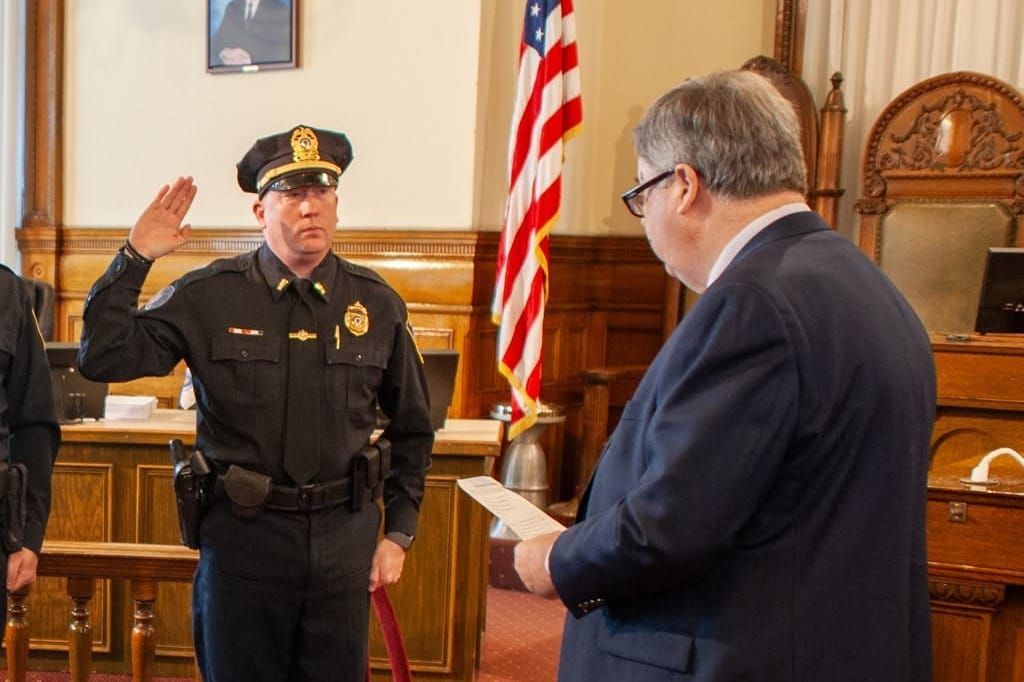
Brockton Police Chief Brenda Perez promoted Graham to lieutenant in April 2024, four months after Gildea ruled that the officer had included false information in the affidavit, according to city council meeting minutes.
In a Facebook post at the time, the department welcomed Graham and seven other officers who received promotions to the “leadership team” and said they would “be vital in guiding and mentoring their fellow officers.”
Online records of the Massachusetts Peace Officer Standards and Training (POST) Commission show that both Graham and Donahue have valid law-enforcement certification and continue to be employed by the Brockton Police Department.
The POST Commission’s online disciplinary database, which was last updated on June 4, does not list any findings of misconduct by Graham or Donahue. A police department is only required to report allegations of misconduct to the POST Commission if its own internal investigation determines that wrongdoing occurred.
Asked whether the POST Commission is conducting its own review of Graham’s conduct in the Mallory case, a spokesperson said the agency “cannot confirm or deny the existence of any investigation and cannot comment on matters that may be pending.”
The Mass Dump submitted public records requests for Graham and Donahue’s internal affairs records to the Brockton Police Department on June 17. That same day, the Dump also sent a request to the Plymouth County District Attorney’s Office for any disclosures about the two officers that prosecutors have made to defendants in criminal cases.
Prosecutors are required to provide defendants with Brady disclosures—which are named after a 1963 US Supreme Court decision—about alleged misconduct by officers testifying against them so that defendants can challenge the officers’ credibility in court.
The district attorney’s office says on its website that it maintains a “Brady Database” with information about police misconduct, including “judicial findings that specifically call into question an officer’s credibility as a witness.”
The district attorney’s office does not share the database on its website, leaving it unclear whether it includes any information about Graham’s conduct in the Mallory case.
Thanks for reading! Journalism like this takes a lot of time and effort. If you’d like to keep The Mass Dump running, please consider offering your financial support, either by signing up for a paid subscription to this newsletter below, becoming a Patreon supporter, or sending a tip via PayPal or Venmo. Your support pays for original investigative reporting like this. A monthly subscription is just $5.
Even if you can’t afford a paid sub, please sign up for a free one to get news about wrongful convictions, police misconduct, public records, and stuff like that—and please share this article on social media.
You can follow me on Bluesky and Mastodon. You can email me at aquemere0@gmail.com.
That’s all for now.